7-Eleven Franchise Cost: The Complete Breakdown
Updated
TL;DR — Key Facts
- →Franchise fee: $10,000–$1,000,000+ depending on store type and market.
- →7-Eleven takes 50–52% of gross profit - a "split" model unlike most franchises.
- →They provide the store, equipment, and inventory - your cash injection pays for the right to operate.
- →Stores in mature markets cost more but generate more. High variance in profitability.
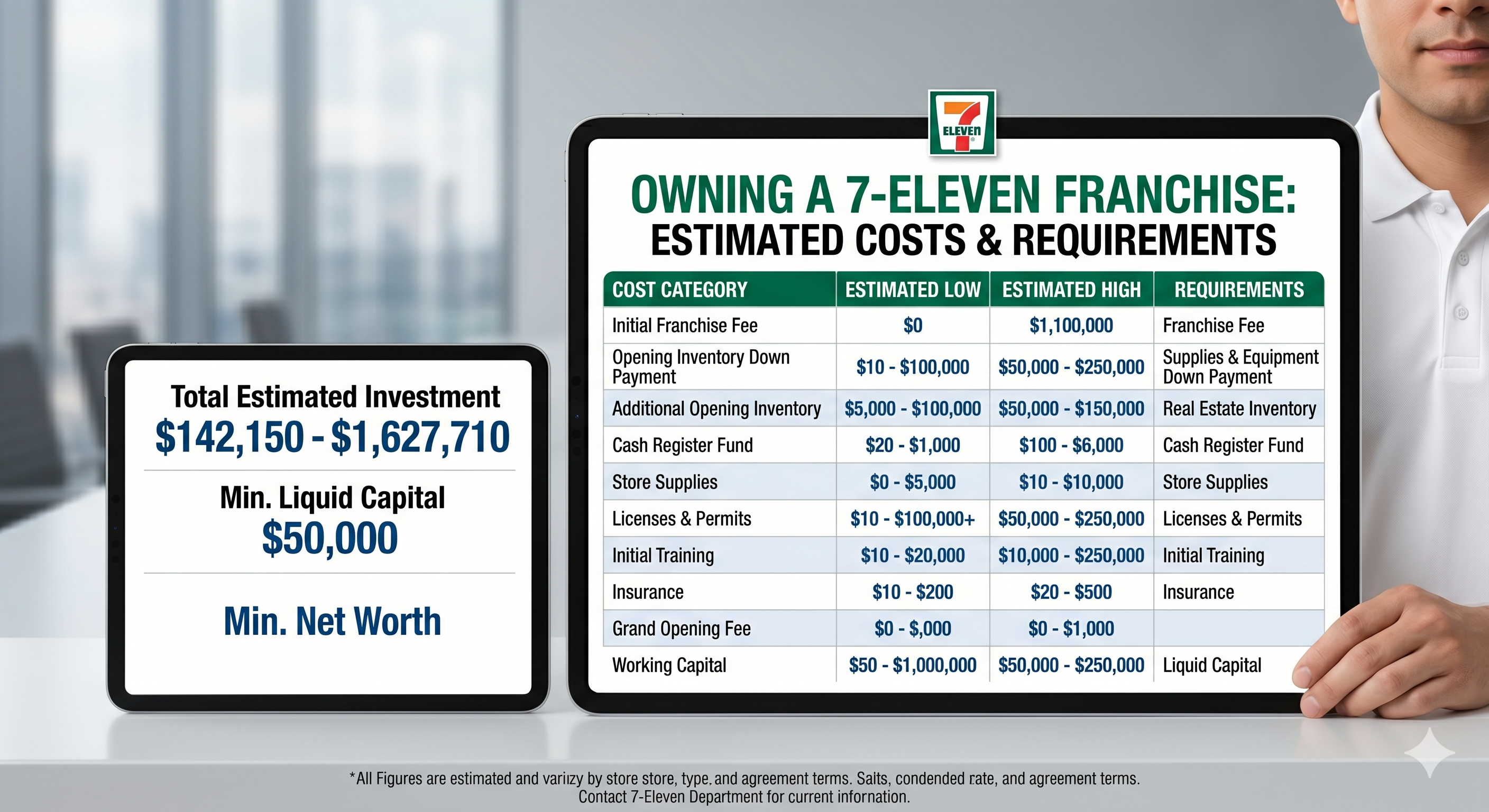
How 7-Eleven's Model Differs From McDonald's, Chick-fil-A, and Other Franchises
7-Eleven operates one of the most unusual franchise models in the industry - one that often confuses buyers comparing it to QSR or service franchises.
The standard model: you pay a franchise fee, build out a store, and pay royalties on your revenue — like Chick-fil-A or Dunkin'. 7-Eleven's model: they provide the store, the equipment, the inventory financing, and often the real estate - and in return, they take 50–52% of your gross profit, every week.
This is called the "gross profit split." It's not a royalty percentage of gross sales - it's a split of actual gross profit (revenue minus cost of goods sold). 7-Eleven gets roughly half of everything the store earns before your labor and utility costs.
The upside: lower upfront capital requirement for existing stores. The catch: you're permanently splitting your earnings with 7-Eleven corporate.
7-Eleven Franchise Cost Breakdown: Existing Store vs. New Construction
Existing store acquisition (most common): The "franchise fee" for an existing store is the store's goodwill value - tied to its annual gross profit.
- Low-volume store in a secondary market: $10,000–$150,000
- Average-volume store in a suburban market: $150,000–$400,000
- High-volume store in a major metro: $400,000–$1,000,000+
- Premium location: $1,000,000+
What's included: 7-Eleven provides: land/building use (via their lease), equipment and fixtures, initial inventory, bookkeeping and accounting, store systems. You provide: labor (employees), most utilities, local marketing.
For SBA financing options on the cash injection, see the SBA 7(a) loan guide.
How 7-Eleven's Gross Profit Split Works — and What Owners Actually Take Home
Example math on a store doing $1,500,000 in annual gross sales: - Assume a 35% gross margin (typical convenience): $525,000 gross profit - 7-Eleven's 50% share: $262,500 - Your 50% share: $262,500 - Subtract labor (yourself + 3–4 part-time employees): $120,000–$160,000 - Subtract utilities: $24,000–$36,000 - Remaining income: $66,000–$118,000
On a higher-volume store doing $2,500,000 gross sales at 33% margin: - Gross profit: $825,000 - Your 50% share: $412,500 - Labor + utilities: $150,000–$200,000 - Income: $212,000–$262,000
Volume is everything. Low-volume stores generate insufficient gross profit to clear the split and still pay yourself. Buyers who focus only on the franchise fee and overlook the annual gross sales figure of a target store are making the costlier mistake.
For a week-by-week breakdown of how the calculation works, see 7-Eleven's gross profit split explained.
Real 7-Eleven Owner Income: What a $220K Investment Returned in Year One
In late 2023, a buyer in Phoenix acquired an existing 7-Eleven doing $1.8M in annual gross sales. The store's goodwill value (franchise fee) was $220,000, paid in cash at closing. 7-Eleven provided the lease, equipment, and initial inventory.
Year one: gross margin came in at 32%, producing $576,000 in gross profit. 7-Eleven's 50% share: $288,000. The operator's share: $288,000. After three part-time employees ($78,000), utilities ($28,000), and miscellaneous operating costs ($14,000), the owner cleared $168,000 - a 76% first-year cash-on-cash return on a $220,000 investment.
Not every store performs like this. The same buyer evaluated a lower-volume location doing $950,000 in annual sales. At 32% margin and the 50/50 split, that store generated roughly $72,000 in operator income before labor. That's not a business - it's a job with capital at risk. Store selection is the decision.
See how much 7-Eleven franchise owners make across different store volume tiers.
What a 7-Eleven Franchise Costs in Canada
7-Eleven runs the same gross-profit-split model in Canada, but the entry numbers and the competitive picture differ enough to matter.
| Line item | Canada | United States |
|---|---|---|
| Franchise fee | $25,000 CAD | $10,000–$1,000,000+ USD (volume-based goodwill) |
| Total investment | $50,000–$500,000 CAD | $50,000–$1,000,000+ USD |
| Royalty | None — gross profit split | None — gross profit split |
| Franchisee share of gross profit | ~52% | ~48–50% |
| Typical break-even | ~30 months | ~30 months |
There are 700+ 7-Eleven locations across Canada. The Canadian split is slightly more favourable to the operator — 7-Eleven typically retains about 48% of gross profit against the franchisee's 52%, out of which the franchisee still covers labour, utilities and operating costs. As in the US, the split is permanent: running the store better raises the dollars, never the percentage.
Canadian store economics typically run $800,000 to $2,500,000 in annual sales, producing operator net income of roughly $50,000 to $180,000 CAD depending on location, competition and how many hours the owner works themselves. Tobacco and beverages account for 40–50% of sales, hot food and Slurpee programs 15–25%, and ATM and lottery commissions another 5–10%.
Two Canada-specific site factors. In Quebec, the dépanneur network is dense and long-established, so the "no competing convenience store within 300m" test is much harder to satisfy than in a comparable US suburb. And Canadian tobacco margins are regulated differently province to province, which shifts the mix on what is still the single largest sales category.
Because there is no royalty to negotiate and no way to improve your share, the location decision carries even more weight than it does on a conventional royalty model — see how the gross profit split works for the full mechanics.
Is a 7-Eleven Franchise Worth It in 2026? An Honest Take
7-Eleven works well for: - Operators who want a recognized brand with an existing customer base - Buyers with limited capital who want to enter a high-visibility retail location — see franchises under $50k if the entry cost here is still out of reach - Buyers comfortable with a split model where corporate takes a fixed share of profit regardless of effort
7-Eleven challenges: - The gross profit split is permanent - good operations don't increase your share percentage - High-volume locations cost significantly more upfront - Most locations require 24/7 operation, often with the franchisee working overnight initially - Competition from dollar stores and gas station convenience is increasing
For a full pros/cons breakdown, see Is a 7-Eleven franchise worth it in 2026?
Before signing anything, score the trade area. A 7-Eleven in a high-foot-traffic corridor with low competitive saturation outperforms a location on the wrong block by $200,000+ in annual gross sales.
On financing: 7-Eleven acquisitions are commonly funded with an SBA 7(a) loan at 10% down. Check what lenders require first, then model the payment against your projected split with the DSCR calculator.
Read Next
Guide
7-Eleven Gross Profit Split Explained
7-Eleven takes 50–52% of gross profit — not gross sales. That distinction changes everything. Here's exactly how the split is calculated and what you keep.
Guide
Is a 7-Eleven Franchise Worth It?
Is a 7-Eleven franchise worth buying in 2026? Honest answer: it depends entirely on which store you pick. Here's when the numbers work — and when they don't.
Financing
SBA 7(a) Loan Explained: Requirements, Rates, and the Real Timeline
The small business administration 7(a) loan goes up to $5 million. Here's what rates look like, who qualifies, and how to cut the 60–90 day timeline.
Guide
Franchises Under $50,000 Total Investment: 12 Legitimate Options
Under-$50K franchises are home-based service businesses - no storefront. Real FDD costs, earnings data, and 12 legitimate options for 2026.
Your Next Step
This article is for informational purposes only and does not constitute financial, legal, or investment advice - consult a licensed professional before making acquisition or financing decisions.
Score a 7-Eleven target address before you buy the franchise.
Free guide — delivered to your inbox.
No spam. Unsubscribe any time. Our privacy policy explains how we store and use your email.
Frequently Asked Questions
How much does a 7-Eleven franchise cost?
What is 7-Eleven's gross profit split?
How much do 7-Eleven franchise owners make?
How much does a 7-Eleven franchise cost in Canada?
Does 7-Eleven require 24/7 operation?
Enter your capital and credit profile. See which franchise price bands you actually qualify for.
See what total investment you can afford →Score a Location
By FundBizPro Editorial · Published 2025-11-08 · US & Canada
Written by
FundBizPro Editorial Team
Independent research from FDD filings and primary sources
The FundBizPro Editorial Team covers North American franchise costs, FDD analysis, site selection, and acquisition financing. Articles draw on current FDD filings and primary industry sources and are reviewed before publication. Content is educational only and is not a substitute for advice from a licensed professional.
About our editorial standards →