How to Buy an Existing Business with No Money Down
Updated
TL;DR — Key Facts
- →SBA 7(a) loans cover acquisitions up to $5 million and require a 10% equity injection - that injection can come from ROBS, a standby seller note, or home equity, not just personal cash.
- →ROBS (Rollover for Business Startups) requires at least $50,000 in a qualifying retirement account; setup costs $5,000–$10,000 through a ROBS provider like Guidant or Benetrends.
- →Lenders apply a DSCR floor of 1.25x - the business must generate $1.25 in cash flow for every $1.00 of combined debt service before any acquisition loan is approved.
- →Pure 100% seller financing bypasses the SBA entirely and works best with retirement-motivated sellers who prefer installment income over a lump sum at closing.
- →For acquisitions under $50,000, the SBA microloan program offers up to $50,000 through nonprofit intermediary lenders with lighter requirements than a 7(a) loan.
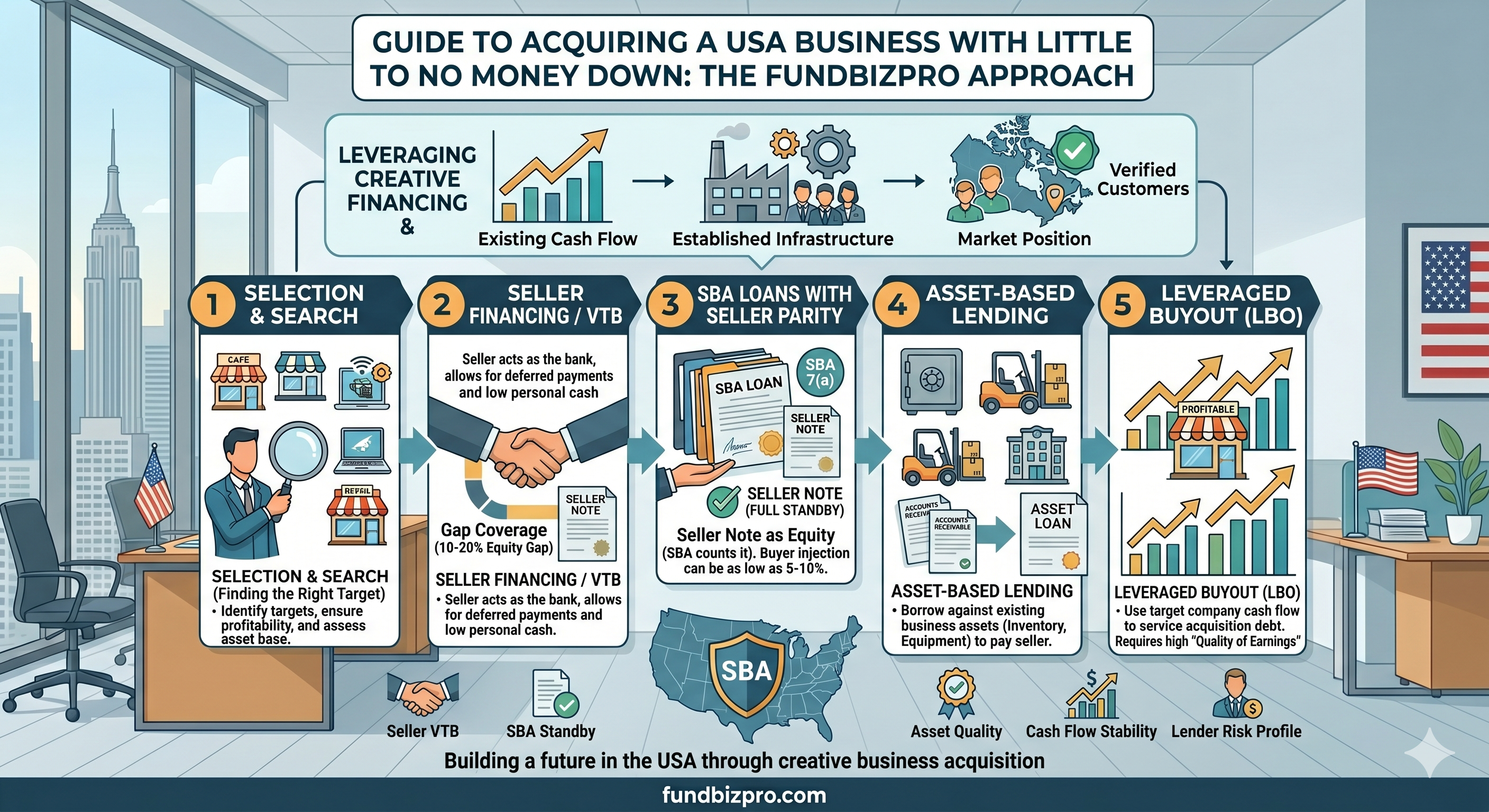
What "no money down" actually means
The phrase is misleading. Outside of zero-equity scams, no business acquisition closes without someone putting capital at risk - either the buyer, the seller, or a lender. "No money down" really means no cash out of the buyer's bank account at closing.
There are four legitimate structures where this is true: 1. SBA 7(a) loan with a 100% standby seller note covering the 10% equity requirement 2. ROBS (Rollover for Business Startups) using existing retirement funds, not personal savings 3. Pure seller financing (100% of the purchase price paid over time from business cash flow) 4. Earnout structures where part or all of the price is contingent on future performance
None of these are free capital. Each transfers risk to a different party. The best structure depends on what the seller will accept, what the business can support, and what the buyer actually brings to the table - because even "no money down" deals require the buyer to bring management skill, industry experience, or operational value.
Structure 1: SBA 7(a) with a full-standby seller note
The SBA 7(a) program covers acquisition loans up to $5 million and requires buyers to inject at least 10% equity. That equity does not have to be cash - if the seller agrees to carry the full 10% as a standby seller note, the buyer contributes zero dollars at closing while satisfying the SBA requirement.
Full standby means the seller receives no principal or interest payments for the first 24 months of the SBA loan. Starting at month 25, the seller note begins a separate amortization while the SBA loan continues. This structure is documented in SBA SOP 50 10 6 and is most common when the buyer and seller already have a working relationship - former employees buying out their employer is the classic case.
On a $1 million acquisition: the SBA 7(a) loan funds $900,000, the seller carries $100,000 on 24-month standby, and the buyer brings no cash to closing. Monthly SBA payments come from business cash flow. Before the seller note activates, the deal must clear the lender's DSCR floor - typically 1.25x - meaning the business must generate $1.25 in cash flow for every $1.00 of the SBA payment alone.
For acquisitions under $50,000 - a small service route or part-time cleaning franchise - the SBA microloan program offers up to $50,000 through nonprofit intermediary lenders with lighter documentation than a 7(a) loan. It is a different pipeline but worth knowing about for smaller targets.
Structure 2: ROBS (retirement rollover)
ROBS lets you invest existing retirement funds into a business acquisition without paying the 10% early withdrawal penalty or income tax at the time of transfer. The money is not a loan - it becomes equity in your new corporation, with no interest and no debt service.
The mechanics: form a C-corporation, create a new qualified 401(k) plan inside the corporation, roll existing retirement funds into the new plan, and have the plan purchase stock in the corporation. The corporation uses that capital to close the acquisition.
ROBS requires a minimum $50,000 in a qualifying retirement account - 401(k), traditional IRA, or certain defined-benefit plans - to make the setup economics work. Setup runs $5,000–$10,000 through a ROBS provider: Guidant Financial, Benetrends, and FranFund are the three largest. Annual compliance filings are mandatory. The IRS scrutinizes ROBS transactions, so proper setup and ongoing administration are not optional - cutting corners here creates significant tax exposure.
The most common real-world no-money-down structure: ROBS covers the 10% SBA equity injection, and a 7(a) loan funds the remaining 90%. The buyer uses retirement capital as the down payment, the SBA loan handles the rest, and no new personal savings are touched at closing. The trade-off is risk: if the business fails, the retirement funds are gone, and there is no bankruptcy protection for the rolled-over amount.
Structure 3: 100% seller financing
In a pure seller-financed deal, the seller becomes the bank. The buyer signs a promissory note for the full purchase price, pays over 5–10 years with interest, and takes over operations. No bank, no SBA, no third-party lender.
This is the cleanest "no money down" structure - but it requires the seller to agree to something most sellers will not: receiving their money over 10 years instead of at closing. Sellers who accept 100% financing typically fit one profile: - They are retirement-age with no succession plan - The business has been listed for 6+ months with no qualified buyer - They prioritize the business continuing over maximizing immediate liquidity - They trust the buyer (often a family member, former employee, or industry peer)
Terms on 100% seller financing usually include: 6–8% interest rate (sometimes lower for family), 5–10 year amortization, personal guarantee from the buyer, security interest in the business assets, and a non-compete if the seller stays involved.
The biggest risk for the buyer: the seller has ongoing leverage. If you default, they can reclaim the business. If you want to sell the business later, you typically need the seller's consent while the note is outstanding. Read the promissory note carefully - some sellers include acceleration clauses that trigger full repayment on sale, refinance, or major operational changes.
Structure 4: earnout
An earnout ties part of the purchase price to future performance. Instead of a fixed price at closing, the buyer pays a base amount plus additional payments over 2–5 years if the business hits agreed-upon revenue or profit targets.
Example structure on a $1.5M business: $500,000 at closing (financed through SBA or other means), $1,000,000 earnout paid over 4 years at 25% per year, conditional on the business maintaining its current EBITDA level.
For the buyer, this reduces the upfront financing need substantially and protects against overpayment if the business underperforms post-sale. For the seller, it extracts a higher total price and keeps them engaged in a smooth transition.
Pure earnouts (no cash at closing) are rare and only work when the seller has strong confidence in the buyer and the business. Hybrid earnouts combined with an SBA loan are more common: the SBA loan handles the base payment, and the earnout covers the stretch portion of the price the valuation would not support.
Earnouts require careful legal drafting. Disputes arise when the buyer changes the business in ways that affect the earnout metrics - cutting marketing, hiring aggressively, or investing in growth can all legitimately reduce near-term EBITDA while being the right long-term moves. The purchase agreement must specify what operational changes are allowed and how the earnout is measured.
Who actually sells this way - the silver tsunami
No-money-down structures only work when the seller agrees. The single largest pool of willing sellers in the US right now is the silver tsunami - roughly 10 million businesses owned by baby boomers who are entering retirement age over the next decade.
The profile matters. A boomer owner who built a business over 30 years, has no children interested in the business, and wants to retire in 18 months has very different motivations than a private equity firm selling a portfolio company. The boomer is often willing to accept creative structures - standby seller notes, earnouts, even 100% financing - because: - They want the business they built to continue - They know the buyer, or can evaluate the buyer's fit personally - They prefer steady income in retirement over a lump sum they would have to reinvest - They have tax reasons to spread the gain over multiple years
This is where the buyer's relationship, industry credibility, and transition plan matter more than their bank balance. A buyer who spent 10 years as the operations manager has a better shot at a no-money-down deal with the owner than a buyer with $300K cash and no industry experience.
The practical step: look at businesses that have been listed for 90+ days, target owners over 60 with no named successor, and lead with a transition plan - not a lowball offer.
What the lender / seller will still want from you
No cash does not mean no requirements. Every no-money-down structure will still ask for:
- Clean personal credit. SBA deals require 680 or higher for most lenders; direct seller financing typically tolerates 650 or higher. Below 620, almost every structure stalls.
- Relevant management or industry experience. Lenders and sellers both want evidence the buyer can operate the business. A resume showing P&L responsibility carries more weight than a business plan.
- A personal guarantee. Every structure involves personal liability for the buyer. There is no structure that fully insulates you from the business's failure.
- A transition plan. Sellers willing to accept creative terms want evidence the business will survive the handoff. A written 90-day operating plan signals seriousness. "I'll figure it out" ends the conversation.
- Debt service coverage. Lenders set a DSCR floor of 1.25x - the business must generate $1.25 in operating cash flow for every $1.00 of combined annual debt service on all loans. If the combined SBA payment and standby seller note exceed what the business generates at 1.25x coverage, the structure fails even if both sides want the deal.
- Location and market validation. All debt structures assume the business continues to generate cash flow. A deteriorating location or shrinking local market makes no creative structure viable - which is why scoring the address before signing matters.
Read Next
Guide
How to Buy an Existing Business (Complete Guide)
How to buy an existing business in 2026: deal sourcing, due diligence, valuation, and SBA financing. Step-by-step process from first search to closing day.
Canada
Buy an Existing Business in Canada: The Immigrant Buyer's Complete Guide
How to buy an existing business in Canada as an immigrant buyer: BDC financing, Quebec franchise rules, provincial nominees, and which categories work.
Guide
How to Buy a Business: A Step-by-Step Guide for First-Time Buyers
How to buy a business: from sourcing deals to SBA financing and closing. Covers due diligence, franchise resales, location scoring, and key red flags.
Financing
SBA 7(a) Loan Explained: Requirements, Rates, and the Real Timeline
The small business administration 7(a) loan goes up to $5 million. Here's what rates look like, who qualifies, and how to cut the 60–90 day timeline.
This article is for informational purposes only and does not constitute financial, legal, or investment advice - consult a licensed professional before making acquisition or financing decisions.
Looking for a seller who will accept a creative structure? Let us know what you are targeting.
Free guide — delivered to your inbox.
No spam. Unsubscribe any time. Our privacy policy explains how we store and use your email.
Frequently Asked Questions
Is buying a business with no money down legal under SBA rules?
Will the seller know I have no cash for the down payment?
Can I use a home equity line of credit as my SBA equity injection?
How long does 100% seller financing take to close compared to SBA?
What is the biggest risk when you buy a business with no money down?
Do I still need a business valuation if there is no bank involved?
Can an immigrant buyer use ROBS or seller financing to buy a US business?
Before you sign a lease, know what the data says about your address.
Score a franchise location free →Score a Location
By FundBizPro Research · Published 2026-04-18 · Updated 2026-05-02 · United States
Written by
FundBizPro Research Team
Independent research from primary sources
The FundBizPro Research Team writes from primary sources - government program documentation, SBA SOP language, lender-published rate sheets, and FDD filings - rather than aggregating other websites. Content is educational only and is not a substitute for advice from a licensed professional.
About our editorial standards →