Franchise Disclosure Document Red Flags Every Buyer Must Know
Updated
TL;DR — Key Facts
- →US law requires the FDD 14 days before signing - franchisors cannot waive this.
- →No Item 19 means the franchisor won't show you real unit-level earnings data.
- →Item 20 exit rates above 25–30% over three years signal serious system problems.
- →Item 21 audited financials reveal whether the franchisor survives your 10-year term.
- →Renewal clauses can reset your royalty rate and territory on the franchisor's terms.
- →Use FundBizPro's free FDD Red Flag Scorer to check any franchise before you sign →
TL;DR
• US law requires the FDD 14 days before signing - franchisors cannot waive this. • No Item 19 means the franchisor won't show you real unit-level earnings data. • Item 20 exit rates above 25–30% over three years signal serious system problems. • Item 21 audited financials reveal whether the franchisor survives your 10-year term. • Renewal clauses can reset your royalty rate and territory on the franchisor's terms.
Use FundBizPro's free FDD Red Flag Scorer to check any franchise before you sign →
What the FDD actually is - and why most buyers skim it
The franchise brochure promises recurring income, proven systems, and brand support. The Franchise Disclosure Document is the legal record of what you actually agreed to - and franchisors have a clear financial interest in making sure you don't read it carefully.
In the United States, federal law requires franchisors to deliver the FDD at least 14 calendar days before any agreement is signed or any money changes hands (per the FTC's Franchise Rule, 16 CFR Part 436 - see ftc.gov/tips-advice/business-center/guidance/franchise-rule for the current rule text). Canada's rules vary by province: Ontario, Alberta, British Columbia, Manitoba, New Brunswick, and Prince Edward Island all have franchise disclosure legislation with the same 14-day minimum. That window is a legal floor, not a scheduling courtesy.
The FDD contains 23 numbered items. Depending on the system's size and litigation history, it runs anywhere from 100 to 500-plus pages. It covers the franchisor's litigation record, audited financials, franchisee turnover rates, territory rights, and - sometimes - what franchisees actually earn. The items that matter most are the ones buyers read least.
Franchisors are legally prohibited from making earnings claims outside of Item 19. That prohibition exists because verbal projections during the sales process are unverifiable and often optimistic. The FDD is where the real numbers live - if you know which seven items to examine and what silence in those items actually means.
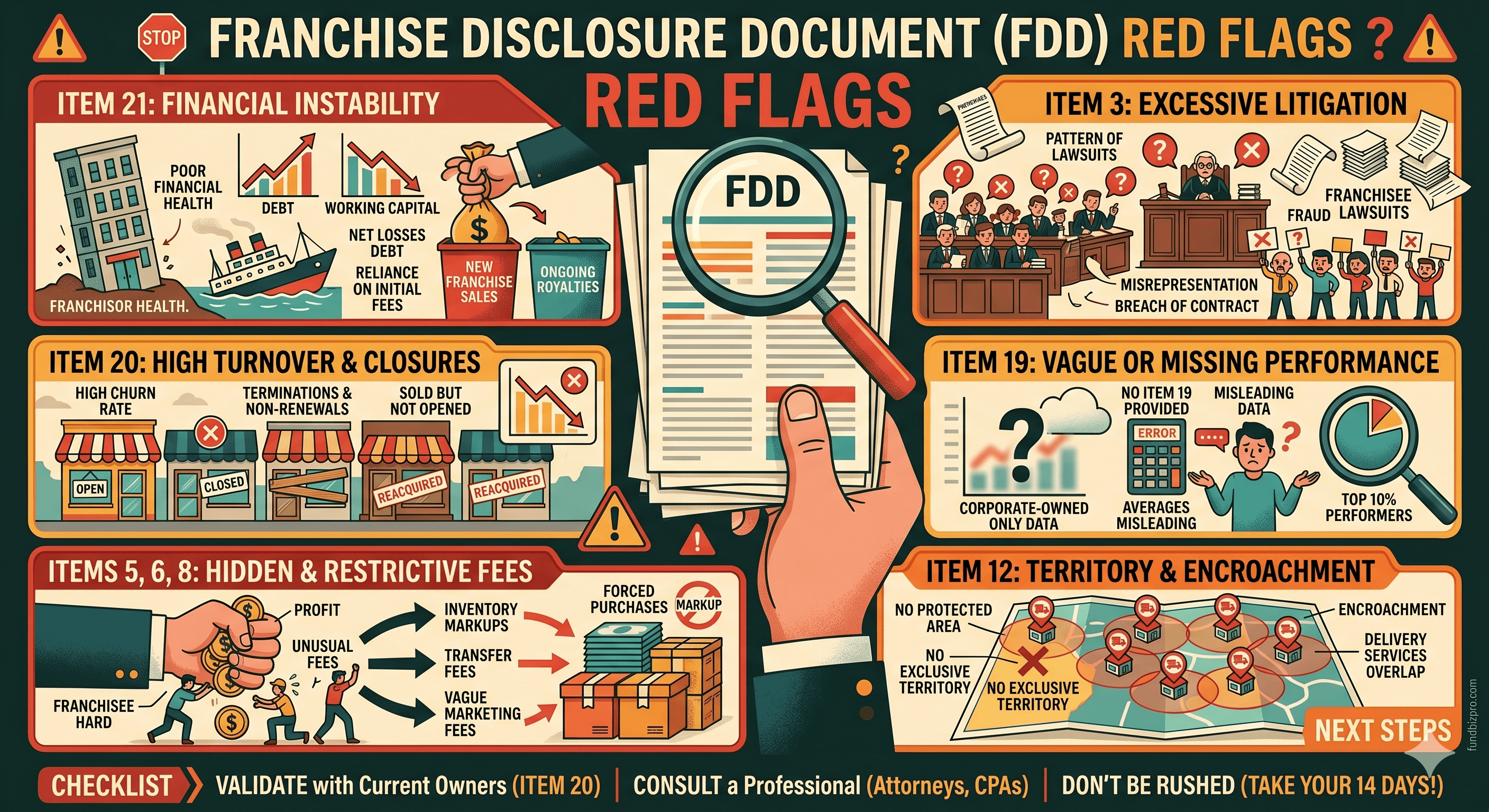
Quick reference: what each red-flag item covers
Before getting into each red flag, here's the map. These are the FDD items that generate the most post-signing regret, and what each one is supposed to disclose.
| FDD Item | What It Covers | Red Flag Threshold |
|---|---|---|
| Item 3 | Litigation history - lawsuits, arbitration, regulatory actions | Repeated claims of the same type across multiple years |
| Item 12 | Territory rights and encroachment protections | Vague qualifiers instead of defined boundaries |
| Item 19 | Financial Performance Representation (unit earnings) | Absent entirely |
| Item 20 | Franchisee turnover - exits, terminations, reacquisitions | Cumulative exit rate above 25–30% over 3 years |
| Item 21 | Franchisor's audited financial statements | Royalty revenue flat or falling; income dominated by new franchise fees |
| Franchise Agreement (Renewal Section) | Renewal terms and conditions | Requires signing then-current agreement at year 10 |
| Site Selection | Not in the FDD at all | No independent trade area validation |
Each item below gets the full treatment. Start with Item 19 - it's where the most money is hidden.
Red Flag 1: Item 19 is blank
Item 19 of the FDD is the Financial Performance Representation - the only section where franchisors can disclose actual earnings data from operating locations. They are not legally required to include it. Many don't.
When a franchisor skips Item 19, the standard explanation sounds reasonable: 'Results vary too much by market' or 'We don't want to set unrealistic expectations.' Neither justification survives scrutiny. If unit economics were strong and consistent, disclosure would be a recruiting advantage. Franchisors with genuinely profitable systems use Item 19 as a selling point because the numbers help close deals. Silence is a data point.
Absence of Item 19 doesn't automatically disqualify a franchise. It does remove your only source of audited financial performance data, leaving you reliant on conversations with existing franchisees - a pool the franchisor can curate when they hand you a referral list.
If Item 19 does exist, read the footnotes before you read the headline figure. Many Financial Performance Representations report average gross revenue that includes only the top quartile of performers, or that quietly excludes locations closed in the prior year. The number is technically accurate. It is not the number the franchisor intends you to carry out of the room. FundBizPro's guide to reading franchise Item 19 data walks through common footnote traps in detail.
Red Flag 2: High franchisee turnover in Item 20
Item 20 is the most underread section in any FDD. It lists every franchisee who left the system in the past three years - transfers, terminations, non-renewals, and locations reacquired by the franchisor. It also contains contact information for those departed operators. Most buyers never call them.
Reading Item 20 correctly requires three numbers: total franchisees at the start of the three-year window, total new franchisees added during that period, and total exits. If exits are running close to new additions, the system is treading water. If the outlet count is growing while exits are also high, the franchisor is recruiting aggressively while operators churn out the back.
A practical benchmark: divide total three-year exits by the system's size at the beginning of that period. A cumulative exit rate of 15–20% over three years sits in a normal range for most franchise categories. Above 25–30%, demand a written explanation. Above 40%, the explanation had better be extraordinary - and you should still call former operators before accepting it.
The departures list in Item 20 is the most valuable due diligence tool in the entire document. A franchisor can direct you toward satisfied current operators. They have no control over what a former franchisee says when you call them on a Tuesday afternoon. Make those calls before you sign anything.
Benchmark figures are drawn from published franchise industry analyses as of early 2026 - verify against the specific FDD and consult a franchise attorney for current context.
Red Flag 3: Item 21 shows weak or deteriorating financials
Item 21 contains three years of audited financial statements for the franchisor. You are committing to a 10-year agreement. The question Item 21 answers - or fails to answer - is whether this company will still function as a meaningful support organization when year 10 arrives.
Start with royalty revenue trends. If total royalty income is flat or declining while unit counts hold steady or grow, average unit volume is falling. That is a system-level deterioration signal, not a single-location problem.
Then look at the debt and cash position. A franchisor carrying heavy debt relative to assets, with thin cash reserves, has limited capacity to invest in franchisee support, technology updates, or marketing infrastructure. In a system downturn, they have even less. As a representative statement from CPAs specializing in franchise acquisition due diligence reflects: 'The franchisors most likely to cut support the moment revenue dips are the ones who never had enough cash to sustain it - Item 21 tells you that story before you're inside the system.' This reflects a pattern documented across multiple franchise insolvency cases reviewed in professional literature through 2025.
The most specific red flag in Item 21 is revenue composition. If a disproportionate share of the franchisor's income comes from initial franchise fees rather than ongoing royalties, the franchisor needs continuous recruitment to remain solvent. That is a structurally different company than one whose revenue grows as existing franchisees grow. One of those incentive structures protects you. The other doesn't.
Red Flag 4: Territory language without encroachment protection
Item 12 defines your territory - what geography you control, whether that control is exclusive, and what the franchisor can do inside your trade area regardless of your agreement. Franchise lawyers consistently identify this section as the source of the most post-signing disputes, and it is also where vague language is most dangerous.
Many FDDs grant a territory tied to your specific location while quietly reserving the franchisor's right to open additional franchised locations nearby, sell through competing channels inside your trade area, and adjust territory boundaries at renewal. Each of those reservations can cost you real revenue. None will appear in the sales conversation.
Encroachment litigation is not rare. The Tim Hortons franchisee disputes with Restaurant Brands International, years of 7-Eleven operator litigation, and dozens of smaller-brand cases all trace back to territory clauses that seemed adequate until a second location opened nearby. The buyers in those cases had lawyers. They had signed agreements. The language simply didn't protect what they believed it protected.
Four questions to press on before signing: Does the agreement define a Protected Territory with a specific radius or hard boundary? Does that protection cover all company-operated and franchised formats? Can the franchisor open inside your territory if your sales fall below a threshold? What happens to your territory rights at renewal - preserved automatically, or subject to renegotiation? If the answers are vague, that is your answer. Have a franchise law specialist review Item 12 line by line - not a general business lawyer.
Red Flag 5: A pattern in the Item 3 litigation history
Item 3 discloses pending and historical litigation involving the franchisor, its officers, and directors. It includes lawsuits, arbitration claims, regulatory actions, and criminal charges against principals.
Some litigation is expected. A system with several thousand franchisees operating across a decade will generate legal activity. The signal isn't the presence of litigation - it's the pattern.
If the same type of claim appears repeatedly across different franchisees in different years - earnings misrepresentation, territory violation, wrongful termination - that is not coincidence. One claim is an incident. Four claims of the same type across four years is a description of how the franchisor operates.
Regulatory actions from state attorneys general or the FTC carry more weight than private lawsuits. California, New York, Maryland, and Washington have active franchise regulatory regimes with registration and review requirements. If a franchisor has faced investigation or enforcement action in those states, understand what triggered it and what changed afterward. 'We settled without admitting wrongdoing' is a legal outcome, not a clean record. A clean Item 3 means no one has sued them publicly yet - not that no one has a grievance.
Red Flag 6: Renewal terms that reset your deal
Franchise agreements typically run 10 years. Most buyers negotiate hard on initial terms and treat the renewal language as a formality. That is a significant oversight.
The single most consequential renewal clause in most agreements requires franchisees to sign the then-current franchise agreement at renewal - not the agreement you negotiated. Whatever the franchisor is offering new buyers at year 10. Royalty rates can increase. Territory definitions can narrow. Required technology investments can be added. You spent a decade building a customer base, and at renewal the business operates under terms you've never seen.
Some agreements go further: they give the franchisor discretion to decline renewal entirely, particularly if sales benchmarks weren't met. You can build a profitable location and still lose renewal rights if your volume didn't hit a threshold set 10 years earlier in a different market environment.
Renovation requirements are the third version of this problem. Many agreements require franchisees to bring their location up to current brand standards as a condition of renewal. For a restaurant or retail location, that means $150,000 to $400,000 in buildout costs at year 10 - a second capital investment the original pro forma never included. Per FDD disclosures reviewed across major QSR brands in 2025 and 2026, renovation requirements at renewal range from $75,000 to over $350,000 depending on brand and location format.
Read the renewal section of the franchise agreement before you sign the initial agreement. Not when the letter arrives in year 9.
Figures referenced are as of early 2026 - verify current renovation requirements in the specific brand's most recent FDD, Item 11 and the franchise agreement renewal section.
Red Flag 7: Your specific location isn't in the FDD at all
This red flag doesn't appear in any numbered item - which is exactly why it belongs on this list.
The FDD tells you about the franchise system. It tells you nothing about whether the specific address you're considering can generate enough volume to justify your investment. Franchisors have site approval processes, and some offer site selection support. Their criteria are calibrated to generate enough revenue to sustain royalty payments - not necessarily enough to deliver a meaningful return on your capital. Those thresholds are not the same number.
Before signing, independently validate the trade area: competitive density, daytime population, transit access, proximity to existing system locations that could reduce your sales, and the demographic match against the brand's documented customer profile. This work will not be done on your behalf by the franchisor's site team. Their incentive and yours are not identical.
Landlord negotiations routinely take months - in many cases longer than the bank approval process. By the time a site is approved and a lease is near execution, most buyers have invested enough time and momentum that walking away feels costly. Validate the location before that momentum builds, not after.
A real acquisition: what the FDD review actually prevented
A buyer in suburban Toronto was close to signing a QSR franchise agreement with a total investment of approximately $420,000 CAD, financed through $120,000 in personal savings and a $300,000 BDC business loan. During FDD review, her franchise attorney flagged two issues: Item 20 showed 31 terminations out of a 94-unit system over three years - a cumulative exit rate above 33% - and Item 19 was absent entirely. She called four former franchisees from the Item 20 departures list. Three reported that average weekly sales were significantly below what the franchisor's sales team had described verbally. She walked away from the deal. Six months later, the same brand announced a system-wide restructuring and paused new franchise development. The $420,000 stayed in her account.
Figures referenced are as of early 2026 - verify current BDC loan terms at bdc.ca.
Who this level of scrutiny is actually for
This level of FDD review is most critical for first-time franchise buyers with $300,000 to $800,000 in investable capital, buyers financing through personal savings or family contributions rather than institutional credit, and anyone signing a 10-year agreement in a market they haven't operated in before. If you're putting in savings that took a decade to accumulate, the four hours it takes to read Items 3, 12, 19, 20, and 21 is the highest-return activity available to you before signing.
Experienced multi-unit operators with franchise attorneys on retainer and institutional backing still need to read the FDD - but they're less likely to be surprised by what's in it. First-time buyers are the primary targets of territory language that sounds protective but isn't, and renewal clauses drafted to favor the franchisor at year 10.
If you're not willing to make five phone calls to former franchisees listed in Item 20, you are not ready to commit $400,000 to a 10-year agreement. That's not a judgment - it's a description of the minimum due diligence the investment requires.
What to do next
Three actions before you sign anything.
First: pull the most recent FDD and read Items 19, 20, and 21 yourself - not just the summary your attorney provides. The footnotes in Item 19 and the revenue composition breakdown in Item 21 are where the most important information hides.
Second: call at least three franchisees from the Item 20 departures list. Ask each one what their actual gross revenue and net margin were. The franchisor cannot curate this list for you.
Third: validate your specific target location independently before the lease negotiation gains momentum. Competitive density, daytime population, and proximity to other system units are numbers you can pull before committing any capital.
Disclaimer
This article is for informational purposes only and does not constitute financial, legal, or investment advice - consult a licensed professional before making acquisition or financing decisions.
How we researched this
This guide draws on the FTC's Franchise Rule (16 CFR Part 436), provincial franchise disclosure legislation in Ontario (Arthur Wishart Act), Alberta (Franchises Act), and British Columbia (Franchise Act), published FDD disclosures from major QSR and retail franchise brands reviewed in 2025 and 2026, BDC published loan program terms, and franchise attorney commentary documented in professional association publications through early 2026. No franchisor or lender paid for placement or review.
Read Next
Guide
Franchise for Sale: How to Evaluate Before You Buy
How to find and evaluate a franchise for sale in 2026 - resales vs new units, reading the FDD, Item 19 analysis, territory encroachment, and why location is the variable franchisors cannot control for you.
Guide
Franchises with the Highest ROI: What the Data Shows
Which franchise categories produce the highest return on investment in 2026 - owner-operator vs absentee models, what the Item 19 data actually shows, and why location matters more than brand for ROI.
Guide
The Hidden Costs of Opening a Franchise (That Nobody Warns You About)
The real costs of opening a franchise in 2026 - beyond the FDD's total investment range. Pre-opening expenses, working capital gaps, soft costs, and the financial surprises that hit most first-time franchisees.
This article is for informational purposes only and does not constitute financial, legal, or investment advice - consult a licensed professional before making acquisition or financing decisions.
The FDD tells you about the system. FundBizPro tells you about your location. Both matter before you sign.
Free guide — delivered to your inbox.
No spam. Unsubscribe any time. Our privacy policy explains how we store and use your email.
Frequently Asked Questions
What is a franchise disclosure document?
What is Item 19 in a franchise disclosure document?
How do I find out if franchisees are leaving a system?
What is franchise encroachment and how do I protect myself?
Can a franchisor raise my royalty rate when I renew my agreement?
What should I look for in the franchisor's financial statements in the FDD?
Is it worth buying a franchise if there's no Item 19 earnings data?
Before you sign a lease, know what the data says about your address.
Score a franchise location free →Score a Location
By FundBizPro Editorial · Published 2026-04-19 · Updated 2026-04-23 · US & Canada
Written by
FundBizPro Editorial Team
Independent research from FDD filings and primary sources
The FundBizPro Editorial Team covers North American franchise costs, FDD analysis, site selection, and acquisition financing. Articles draw on current FDD filings and primary industry sources and are reviewed before publication. Content is educational only and is not a substitute for advice from a licensed professional.
About our editorial standards →