Small Business Loan for Women: Every Real Option Ranked
Updated
TL;DR — Key Facts
- →SBA 7(a) loans go up to $5 million and have no gender criteria — women qualify on the same credit, cash flow, and collateral terms as any other borrower.
- →Lenders require a minimum 1.25x DSCR before any application proceeds: the business must generate $1.25 for every $1.00 of annual debt service.
- →SBA 7(a) requires a minimum 10% equity injection from verified personal funds. ROBS (Rollover for Business Startups) counts if the qualifying retirement account holds at least $50,000.
- →SBA microloans cap at $50,000 and are distributed through nonprofits like Accion Opportunity Fund and Grameen America — the most accessible entry point when full 7(a) is out of reach.
- →Women-specific grant acceptance rates run under 5%. Amber Grant awards $10,000 monthly. Pursue grants alongside a loan application, not instead of one.
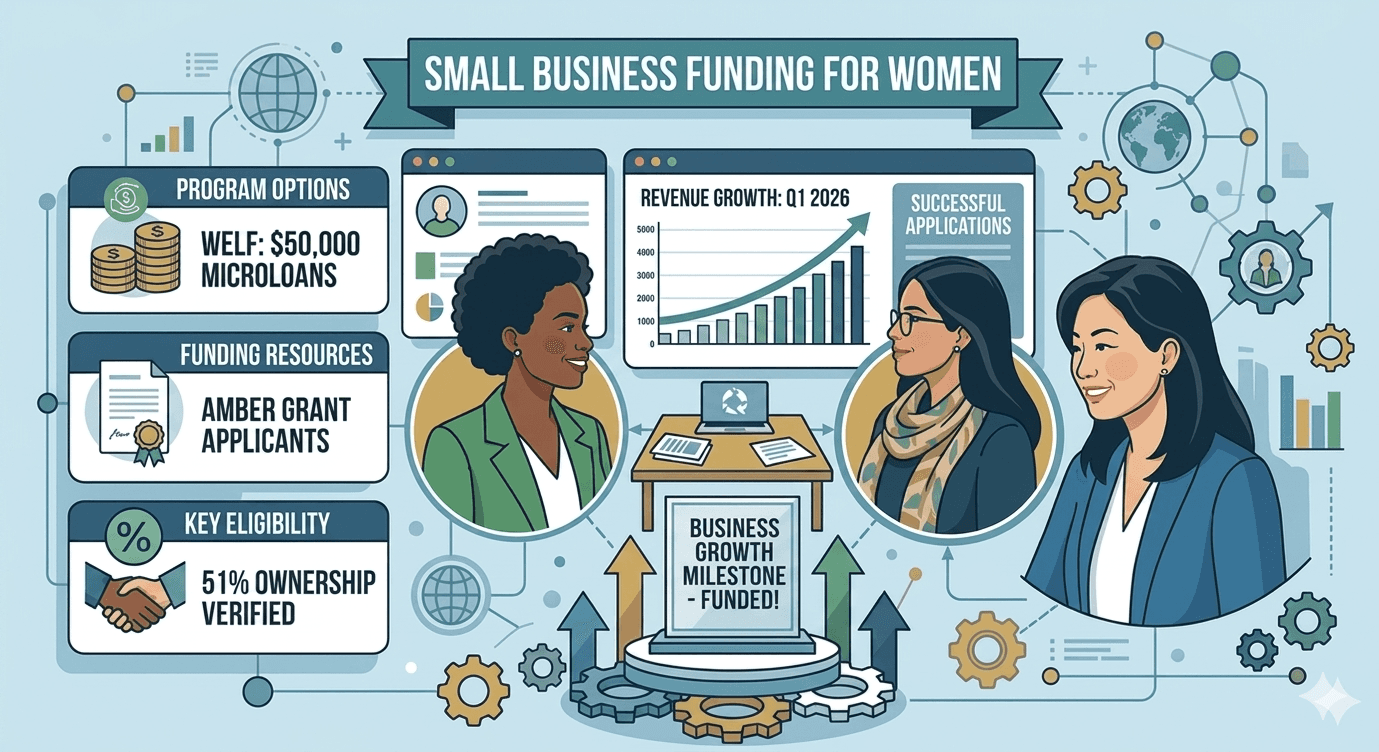
Women-specific vs universal programs: what the distinction means in practice
Every piece of financing available to women-owned businesses falls into one of two categories. The first is universal: standard SBA, bank, and alternative lending that women can access on equal terms. The second is women-specific: a narrower layer of dedicated grant programs, SBA resource centers, certifications, and a handful of loan programs designed for underserved entrepreneurs.
The confusion between these two categories costs buyers time. Some spend months researching women-only programs before discovering that the most accessible, highest-value financing — SBA 7(a), which goes up to $5 million — was available to them all along without any gender criteria. The women-specific layer adds meaningful options in certain situations. It does not replace the standard layer.
This article covers both. Start with the universal programs, because that is where the capital is. Layer in the women-specific tools where they actually change your outcome.
SBA programs: the starting point for most buyers
The SBA does not discriminate by gender. SBA 7(a) and 504 loans are evaluated on credit score, Debt Service Coverage Ratio (DSCR), collateral, and relevant experience — the same criteria applied to every applicant. Women-owned businesses qualify on identical terms. The threshold that matters most: a 1.25x DSCR minimum, meaning the business must generate $1.25 for every $1.00 of annual debt service before any SBA lender will proceed.
What the SBA has built specifically for women is infrastructure, not a separate loan product.
SBA Women's Business Centers operate at over 130 locations across the US, funded by the SBA and run by local nonprofits. WBC counselors provide free and low-cost business counseling, loan application preparation, and direct introductions to SBA lenders active in women-owned business lending. A warm WBC introduction is worth more than a cold application — lenders who know a WBC is vouching for a borrower's preparation pay attention. Find your nearest center at sba.gov/local-assistance.
SBA Community Advantage loans are made by mission-driven CDFIs and nonprofits with SBA backing, reaching $350,000. Women, veterans, and minority-owned businesses in underserved markets are the explicit target audience. Criteria are more flexible than standard SBA 7(a).
The SBA microloan program provides loans up to $50,000 through SBA-approved nonprofit intermediaries rather than banks. Most microloan programs treat women-owned businesses as a priority. Interest rates run 8%–13%, terms up to six years. The average SBA microloan is approximately $14,000. For small financing needs with limited credit history, this is typically the most accessible institutional entry point.
SBA program terms are as of April 2026. Verify current figures at sba.gov/funding-programs/loans.
CDFIs: the most underused financing option for women
Community Development Financial Institutions — CDFIs — are Treasury-certified lenders whose mission is to serve underserved communities. They operate under different criteria than conventional lenders: lower minimum credit scores, more flexible collateral requirements, and a genuine institutional motivation to find a path to approval rather than applying rigid cutoffs.
For women-owned businesses that don't meet conventional thresholds — credit below 680, limited operating history, thin personal collateral — CDFIs are frequently the most realistic path to affordable term financing.
| Lender | Loan range | Min credit score | Geographic focus |
|---|---|---|---|
| Accion Opportunity Fund | $5,000–$250,000 | ~575 | National |
| Grameen America | $2,000–$15,000 | None | 60+ US cities |
| LiftFund | $500–$1,000,000 | ~575 | South and Southwest |
| OFN directory | Varies | Varies | Search by state |
Accion Opportunity Fund serves women, minority, and immigrant entrepreneurs with rates between 8.49%–24.99%. They lend nationally and accept credit scores around 575 — well below the 680 floor most SBA lenders enforce.
Grameen America specifically targets women with limited income who want to build businesses. No US credit score is required. A group-lending model — where a small group of borrowers co-guarantee each other — substitutes for individual credit underwriting. It establishes credit history that opens better options over time.
LiftFund focuses on women and minority-owned businesses across Texas, Louisiana, and surrounding states, with loan amounts reaching $1 million for established businesses.
The Opportunity Finance Network maintains a searchable CDFI directory at ofn.org, filterable by geography and target market.
CDFI rates and terms are as of April 2026. Verify current figures directly with each lender or at ofn.org.
Women-specific grant programs
Grants for women-owned businesses are real. Acceptance rates make them supplemental capital, not a primary financing strategy. Most competitive programs run acceptance rates below 5%.
Amber Grant awards $10,000 monthly and $25,000 annually to women-owned businesses. No minimum revenue; startups qualify. Applications are relatively straightforward. Monthly grants have lower competition than the annual award. Apply at WomensNet.net.
Hello Alice hosts multiple grant cycles per year from corporate sponsors. Women-owned businesses are a priority category. Award amounts range from $5,000 to $50,000 depending on the cycle. Monitor helloalice.com for open applications.
Tory Burch Foundation Fellows is highly competitive — annual grants of $5,000 plus year-long mentorship, with strong preference for businesses with social impact components. Eileen Fisher Social Innovators awards $10,000–$100,000 annually to women-owned businesses working on environmental or social issues.
State-level programs vary significantly. Your state's Small Business Development Center (SBDC) is the most reliable source for current local and state program availability.
The honest accounting: a well-structured loan reaches closing faster than a grant application that takes 6–12 months with a 95%+ rejection rate. Pursue grants alongside a loan application — the $10,000 Amber Grant changes your down payment math more when it arrives during underwriting than when it's your only plan.
Women Business Enterprise (WBE) certification and what it unlocks
WBE certification, issued by the Women's Business Enterprise National Council (WBENC) or state-equivalent bodies, is a procurement credential. It does not improve loan terms and lenders don't require it.
What it does unlock is corporate and government procurement access. The federal government targets 5% of all contracting dollars to women-owned small businesses. For businesses in professional services, facilities management, IT, and certain manufacturing sectors, WOSB status opens a real contract pipeline that can materially change revenue trajectory.
Major corporations — Walmart, Amazon, JPMorgan Chase, American Express — run supplier diversity programs that prefer or require WBENC certification. It is often a prerequisite for consideration, not a nice-to-have.
Certification requires the business to be at least 51% owned, controlled, and operated by women who are US citizens or permanent residents. The application involves detailed financial documentation and sometimes an in-person interview. It takes 60–90 days and costs $350–$1,000 depending on business revenue.
Pursue WBE certification if your business sells to corporations or governments. Skip it as a financing strategy — it changes nothing in your loan application.
Conventional banks and alternative lenders: no women-specific products, but worth knowing
Major banks don't have women-specific loan products. Chase, Bank of America, and Wells Fargo all operate women in business programs — dedicated relationship managers, networking events, educational resources — but the underlying loan criteria are identical for all qualified borrowers.
Alternative lenders don't differentiate by gender in either direction. OnDeck, Funding Circle, Bluevine, and similar platforms underwrite on revenue, credit score, and business health. Marketing materials may specifically target women, but underwriting thresholds are the same regardless.
Where gender changes the practical experience: CDFIs and WBC-connected lenders are institutionally motivated to serve women-owned businesses. That motivation shows up as more patient underwriting, more willingness to look at the full picture rather than applying a rigid credit score cutoff, and more preparation support during the application process.
If a conventional bank has declined you and you haven't contacted a CDFI or your local WBC, that's the next call. Not because the loan product is different, but because the approach is.
The practical sequence: how to find the right financing
Work through this sequence rather than researching every program simultaneously.
Step one: calculate your DSCR. The business must generate at least 1.25x your projected annual loan payment before any SBA or conventional lender will proceed. If the math doesn't work at your target loan size, no program resolves that. See the loan requirements guide for the formula.
Step two: check your credit score. At 680 or above, start with SBA 7(a) through an SBA Preferred Lender. Contact your nearest WBC first — their warm lender introductions are worth the conversation, and counselors know which lenders in your market have lower overlays.
Step three: at 620–679, contact a CDFI. Accion Opportunity Fund is the national starting point. OFN's directory at ofn.org surfaces regional options by state and target market.
Step four: if your financing need is $50,000 or under, explore SBA microloans through local intermediaries. The SBA lender search tool at sba.gov surfaces approved microloan intermediaries by geography.
Step five: if you have retirement savings of at least $50,000, ask a ROBS specialist whether a Rollover for Business Startups structure makes sense as your SBA equity injection. ROBS converts retirement funds into business capital without triggering early withdrawal penalties. Established providers include Guidant Financial and Benetrends.
Step six: while financing is in progress, check active grant cycles at Amber Grant and Hello Alice. A $10,000 grant is worth pursuing as long as it doesn't delay your loan timeline.
This article is for informational purposes only and does not constitute financial, legal, or investment advice. Consult a licensed professional before making financing or business decisions.
Read Next
Financing
How to Get a Small Business Loan: The Honest Guide
How to get a small business loan - what banks check, why applications fail, and which loan type fits your deal. Real numbers, real lender criteria.
Financing
SBA 7(a) Loan Explained: Requirements, Rates, and the Real Timeline
The small business administration 7(a) loan goes up to $5 million. Here's what rates look like, who qualifies, and how to cut the 60–90 day timeline.
Canada
Buying a Franchise as a New Immigrant to Canada
What new immigrants to Canada need to know about buying a franchise in 2026 - financing without a credit history, the right entry categories, legal protections by province, and how to avoid the mistakes that cost people their savings.
Guide
Franchise Opportunities for Veterans: What You Actually Qualify For
The real veteran franchise programs in 2026 - VetFran discounts, SBA loan advantages, top brands actively recruiting veterans, and how military experience maps to franchise ownership.
This article is for informational purposes only and does not constitute financial, legal, or investment advice - consult a licensed professional before making acquisition or financing decisions.
Before you build your loan file, know what your location can support. Score any address free.
Free guide — delivered to your inbox.
No spam. Unsubscribe any time. Our privacy policy explains how we store and use your email.
Frequently Asked Questions
Are there small business loans specifically for women?
What credit score do women need for a small business loan?
What is the SBA Women's Business Center?
Are small business grants for women real?
Do I need WBE certification to get a small business loan?
What is a CDFI and why does it matter for women-owned businesses?
Answer 10 questions. See which lenders match your profile and what loan types fit.
Check your loan readiness →Score a Location
By FundBizPro Research · Published 2026-04-18 · Updated 2026-05-11 · United States
Written by
FundBizPro Research Team
Independent research from primary sources
The FundBizPro Research Team writes from primary sources - government program documentation, SBA SOP language, lender-published rate sheets, and FDD filings - rather than aggregating other websites. Content is educational only and is not a substitute for advice from a licensed professional.
About our editorial standards →