Best B2B Franchises Under $150,000 Total Investment
Updated
TL;DR — Key Facts
- →Commercial cleaning franchises start at $3,600 total investment with recurring B2B contracts.
- →No commercial lease required -- B2B service franchises operate from a vehicle and home office.
- →Non-food franchises are easier to finance than QSR concepts, per lenders at the 2026 Montreal Expo.
- →Jan-Pro FDD Item 19 supports owner income of $40,000-$120,000 annually by year 3 for active franchisees.
- →Transworld Business Advisors (business brokerage) requires $62,000-$85,000 total; no storefront required.
Why Buyers Keep Looking at B2B Franchises
Consumer-facing franchises get most of the attention. Subway, Tim Hortons, Chick-fil-A, Dunkin': these are brands buyers recognize, and that recognition feels like a head start. The problem is that recognition alone does not pay the commercial lease, the build-out invoice, or the first three months of payroll before revenue stabilizes.
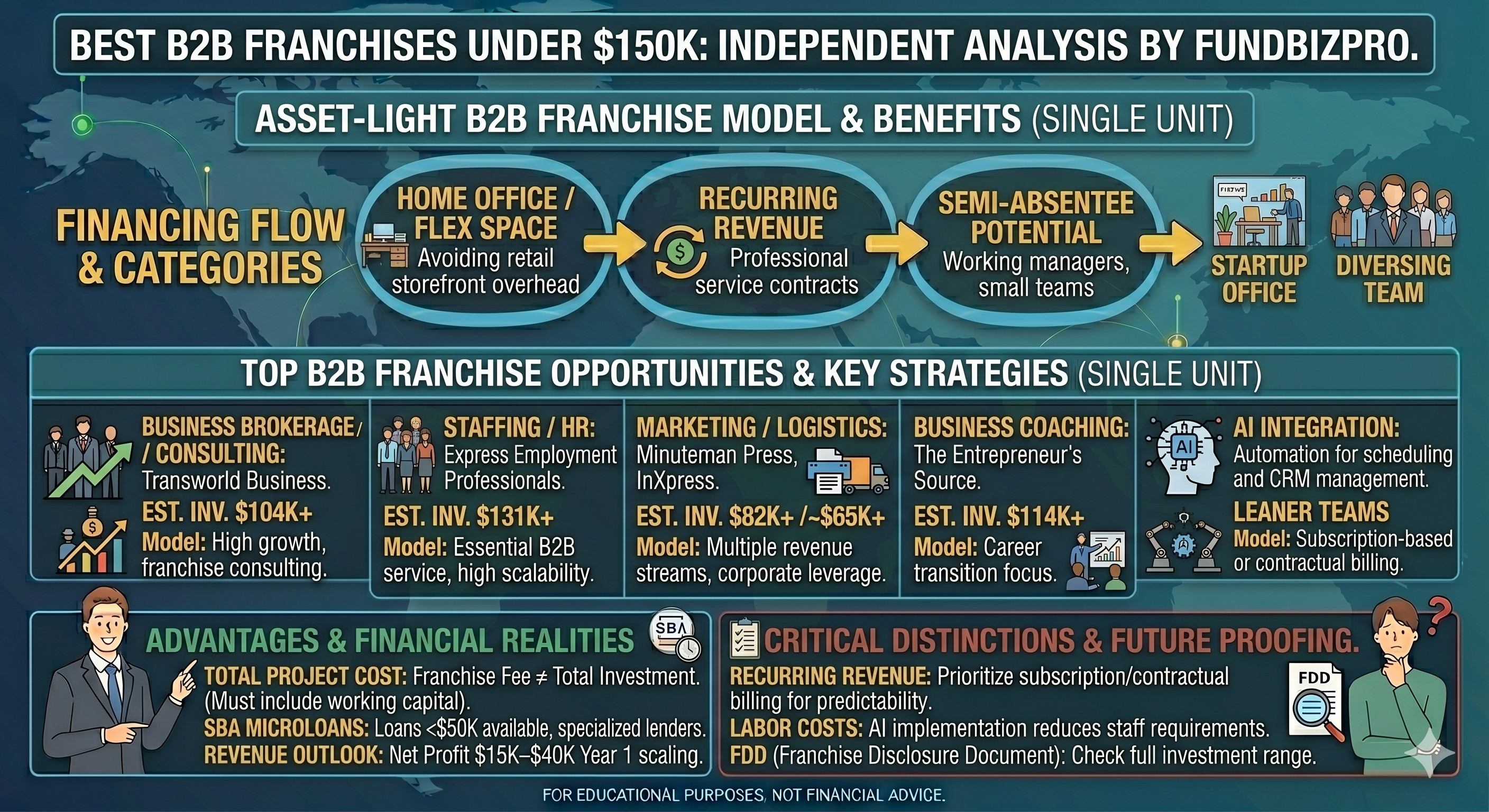
B2B service franchises work from a different model. Your clients are businesses, not walk-in consumers. Revenue comes from recurring contracts rather than daily foot traffic. There is no storefront lease, no public-facing location, and no build-out requirement beyond a vehicle and basic equipment.
At the April 2026 Montreal Franchise Expo, a commercial lender described the financing landscape plainly: construction and non-food franchises are the easiest to get financed -- everything else is a fight with the bank. That observation tracks with SBA lending data. Commercial cleaning and service franchise acquisitions are approved at higher rates than food service concepts because the cash flow is contractual, verifiable, and does not depend on daily consumer behavior.
Most serious buyers at this stage request the Franchise Disclosure Document from two or three brands and compare Items 7, 12, and 19 before narrowing their decision.
B2B Franchises Under $150,000: What Is Actually Available
B2B franchises under $150,000 cluster into four operational categories: commercial cleaning, professional services, travel agency (home-based), and business brokerage. The investment ranges below are drawn from publicly available Franchise Disclosure Documents and reflect FDD Item 7 (Estimated Initial Investment) disclosures for each brand. Ranges vary by territory size and market.
| Brand | Total Investment (FDD Item 7) | Franchise Fee | Business Model | Revenue Type |
|---|---|---|---|---|
| Coverall | $6,100-$38,850 | $6,100 | Commercial janitorial | Recurring contracts |
| Jan-Pro Cleaning and Disinfecting | $4,200-$56,500 | $3,200 | Commercial cleaning | Recurring contracts |
| Jani-King | $3,000-$51,400 | $3,000 (starter) | Commercial janitorial | Recurring contracts |
| Stratus Building Solutions | $3,600-$69,000 | $3,600 | Commercial cleaning | Recurring contracts |
| Dream Vacations | $3,500-$21,500 | $10,500 (new buyer) | Home-based travel agency | Commission-based |
| Transworld Business Advisors | $62,000-$85,000 | approx. $39,000-$70,000 | Business brokerage | Commission on business sales |
All figures are in USD. Verify current investment ranges and FDD disclosures directly with each franchisor before making investment decisions. FDD Item 7 figures referenced are as of 2025-2026 FDD filings -- verify current figures at each franchisor's discovery portal.
The commercial cleaning category dominates for a simple reason: entry is genuinely low, contracts are recurring, and the service is not discretionary. Businesses clean their offices whether the economy is growing or not. That recession resistance makes commercial cleaning franchises easier to finance and easier to underwrite than consumer-dependent revenue models.
FASTSIGNS, a B2B signage and visual communications franchise, is a commonly cited brand in this category. Its total investment runs $231,558-$303,528 per its most recent FDD, which puts it above the $150,000 threshold -- worth noting as a next-tier option for buyers who qualify for larger SBA loans.
What the Brochures Leave Out
Recurring contracts are not guaranteed at signing. Jan-Pro, Jani-King, and similar brands market "initial customer accounts" as part of entry packages. Those accounts are real, but the number of accounts and their size vary by market. Retention depends on service quality. Some franchisees receive fewer accounts than they expected; others lose an initial account in the first 90 days. The FDD Item 19 ranges reflect performance over time, not day-one revenue.
Commercial cleaning is physically demanding work. The franchise fee is low because the labor is yours. Most entry-level franchisees are owner-operators cleaning commercial spaces -- office buildings, retail units, warehouses -- during evenings and weekends while they build the business. The path to higher income runs through hiring employees and managing routes, not through the work becoming easier.
Staffing and brokerage models have longer income ramp times. Transworld Business Advisors (business brokerage) requires building a deal pipeline before generating commissions. Buyers typically take 12-18 months before closing their first transaction. The franchise provides brand, training, and deal-sourcing methodology -- it does not provide immediate income.
Brochures understate the sales component. Commercial cleaning franchisors describe the business as "account-based," which is accurate. What they describe less clearly is that growing beyond the initial accounts requires active prospecting for new contracts. Buyers who underestimate this component often plateau at initial accounts and never reach the income potential disclosed in Item 19.
A Representative Acquisition: Commercial Cleaning in Ohio
A buyer in Columbus, Ohio acquired a Jani-King entry-level franchise in mid-2024 for $8,400 total investment, funded from personal savings. He received three initial commercial cleaning accounts covering approximately 12,000 square feet of office space across two buildings. By month six, he had added two accounts through direct outreach to small businesses near his existing routes and was generating approximately $3,200 per month in gross revenue while working evenings and weekends.
He hired a part-time employee in month eight to cover a larger account he had signed directly. By the end of year one, his service territory covered six accounts generating approximately $4,800 per month in gross revenue.
This is a representative scenario based on typical entry-level Jani-King acquisitions in mid-sized US markets. Territory density, account size, and the franchisee's willingness to pursue new contracts determine the actual ramp timeline. The scenario illustrates the realistic growth profile: accounts grow through active sales, not passive account placement alone.
What B2B Franchisees Actually Earn
Jan-Pro's most recent FDD Item 19 discloses gross revenue ranges for active franchisees across multiple market tiers. Full-time owner-operators in established markets with multiple accounts generate gross revenue that supports owner income in the $40,000-$120,000 range annually by year 3, depending on territory size, account volume, and hours invested. Jani-King publishes comparable Item 19 disclosures. Request the current FDD directly from each brand to review Item 19 data for your target market.
Year-one income for commercial cleaning franchisees is typically 40-60% of year-three income, as franchisees build their client base and learn account management. Franchisees who hire employees and take on larger commercial accounts reach the upper end of the range more quickly than solo owner-operators.
One note on Transworld Business Advisors: the brand has historically left FDD Item 19 incomplete -- it does not publish verified earnings ranges for franchisees. This is worth factoring into due diligence. The commission model is real and can generate substantial income for active business brokers in strong markets, but buyers are evaluating an income potential without a published benchmark.
Dream Vacations also does not publish a standard Item 19 -- commission income depends on booking volume and varies significantly by market. Travel agency franchises are best suited for buyers with existing client networks rather than buyers expecting the franchise to generate clients independently.
For B2B franchises in this budget range, commercial cleaning offers the most transparent Item 19 data and the most predictable ramp profile. Figures referenced as of 2025-2026 FDD filings -- verify current earnings disclosures directly with each franchisor.
Who Succeeds in B2B Franchises
B2B service franchises attract a specific buyer profile. Buyers who do well share a few characteristics: they are detail-oriented, comfortable in client-facing settings, and realistic about the physical demands of the early years. Former facilities managers, corporate cleaning supervisors, and property managers bring directly applicable skills and often win initial contracts faster than buyers without industry background.
Buyers with existing relationships in corporate real estate, office management, or small business networks have a measurable advantage. A single referral from a former colleague can produce a multi-year commercial cleaning contract.
Buyers who struggle in this category typically expect passive income from the franchise structure. Commercial cleaning is not passive. It requires active client management, quality control across accounts, and ongoing prospecting for new contracts. Buyers who underestimate the sales component often plateau at the initial accounts provided at signing and never build to the income potential disclosed in Item 19.
The Dream Vacations and Transworld models attract buyers with professional networks -- travel clients in the first case, business owner relationships in the second. These are not cold-prospecting businesses for buyers starting without an existing network.
The franchise model in every B2B category provides brand recognition, training, and operational systems. It does not provide autopilot income.
Common Next Steps for Serious Buyers
Most buyers at this stage request the Franchise Disclosure Document directly from the franchisor and review Items 7, 12, and 19 before any further conversation with the franchise development team.
Buyers comparing commercial cleaning brands typically review Item 6 (ongoing fees and royalties) side by side -- royalty structures vary meaningfully across Jan-Pro, Jani-King, Stratus, and Coverall, and the differences compound over three to five years of operation.
Buyers considering SBA financing for packages above $50,000 typically contact SBA-preferred lenders who specialize in franchise acquisitions. The SBA's Lender Match tool at sba.gov connects buyers with lenders active in their market.
How We Researched This
This guide references publicly available Franchise Disclosure Documents for Jan-Pro Cleaning and Disinfecting, Jani-King International, Stratus Building Solutions, Coverall, Dream Vacations, FASTSIGNS, and Transworld Business Advisors -- specifically Items 5, 6, 7, and 19 where disclosed. Investment ranges reflect FDD Item 7 data reviewed in 2025-2026 FDD filings. SBA financing notes reference program guidelines at sba.gov. Verify all figures directly with franchisors before making investment decisions.
Read Next
Guide
Franchises Under $50,000 Total Investment: 12 Legitimate Options
Under-$50K franchises are home-based service businesses - no storefront. Real FDD costs, earnings data, and 12 legitimate options for 2026.
Financing
How to Get a Loan to Buy a Business
SBA 7(a), seller notes, ROBS, and conventional loans explained with real numbers. Learn what lenders require to fund a business acquisition in 2026.
Guide
Food Franchise Under $50k: The Honest Answer
No traditional food franchise requires less than $50,000 total investment as of 2026. Here is what real FDD Item 7 data shows, what food-adjacent concepts actually cost, and what $50,000 actually buys in the franchise market.
Guide
Franchise Disclosure Document Red Flags Every Buyer Must Know
7 franchise disclosure document red flags - from missing Item 19 to renewal clauses that reset your deal. Real numbers, FDD items named. Read before you sign.
Your Next Step
This article is for informational purposes only and does not constitute financial, legal, or investment advice - consult a licensed professional before making acquisition or financing decisions.
Score your service territory before buying the franchise rights.
Free guide — delivered to your inbox.
Frequently Asked Questions
What is a B2B franchise?
Can I get an SBA loan for a commercial cleaning franchise?
How much can I earn from a Jan-Pro franchise?
What is the difference between Jan-Pro and Jani-King?
Are B2B franchises easier to finance than food franchises?
Do B2B franchises require a storefront?
Enter your capital and credit profile. See which franchise price bands you actually qualify for.
See what total investment you can afford →Score a Location
By FundBizPro Editorial · Published 2026-05-01 · United States
Written by
FundBizPro Editorial Team
Independent research from FDD filings and primary sources
The FundBizPro Editorial Team covers North American franchise costs, FDD analysis, site selection, and acquisition financing. Articles draw on current FDD filings and primary industry sources and are reviewed before publication. Content is educational only and is not a substitute for advice from a licensed professional.
About our editorial standards →