How to Get a Loan to Buy a Business
Updated
TL;DR — Key Facts
- →SBA 7(a) loans cover up to $5M; minimum buyer cash injection is 10% of purchase price.
- →Lenders require debt service coverage of 1.25x - the business must earn $1.25 per $1.00 of annual debt payment.
- →Seller financing covers 10–30% of most deals; typical seller note rate is 6–8% over 3–7 years.
- →ROBS lets you invest 401(k) funds into a business you own - no early withdrawal penalty, but no recovery if the business fails.
- →Total cash needed at closing on an SBA deal runs 20–25% of purchase price once closing costs and working capital are included - not just the 10% down payment.
- →Use FundBizPro's free Match tool to find SBA-preferred lenders matched to your deal size and industry →
Opener
Most buyers overestimate how hard a business acquisition loan is to get and underestimate how much cash they need at closing. That gap between assumption and reality is where deals fall apart - not at the bank, but at the closing table when the buyer's account comes up short.
The short answer
Three numbers to anchor your planning before you go further. On a $500,000 acquisition, expect $100,000–$125,000 in total cash out of pocket when you include the down payment, closing costs, and a working capital reserve - not the $50,000 that SBA's 10% minimum suggests. Timeline from signed letter of intent to funded loan runs 45–90 days for SBA 7(a), 30–45 days for conventional, and as few as 14 days for seller-financed deals. ROI window: well-structured SBA acquisitions with a DSCR above 1.5x at closing typically reach positive cash flow in year one. Deals priced at the floor of 1.25x DSCR leave no margin for a slow first quarter.
Why business acquisition loans are different from startup loans
Banks have almost no appetite for startup financing because there is no revenue history to underwrite. Acquisition loans are built on something real: three years of tax returns, existing customers, and a cash flow number a lender can stress-test. That makes acquisition financing far more accessible than startup financing, even for first-time buyers.
The catch is that lenders are absorbing the same business risk you are. If revenue drops after you take ownership, the loan still has to be paid. Your down payment is the lender's first buffer. The business's operating cash flow is the second. Your personal credit and any pledged collateral are the third. That layered structure is why lenders scrutinize DSCR, lease terms, and the seller's reason for exiting more than almost anything else.
Here is the skeptical observation most buyers miss: a bank approving your loan does not mean the deal is a good deal. Lenders underwrite to the minimum coverage ratio required by their guidelines, not to the threshold that gives you a comfortable living. A loan that closes at exactly 1.25x DSCR is a loan that leaves you one slow month away from a problem. Know those three metrics - DSCR, lease term, seller's exit reason - before you call a lender.
SBA 7(a) loans: the most common path for deals under $5M
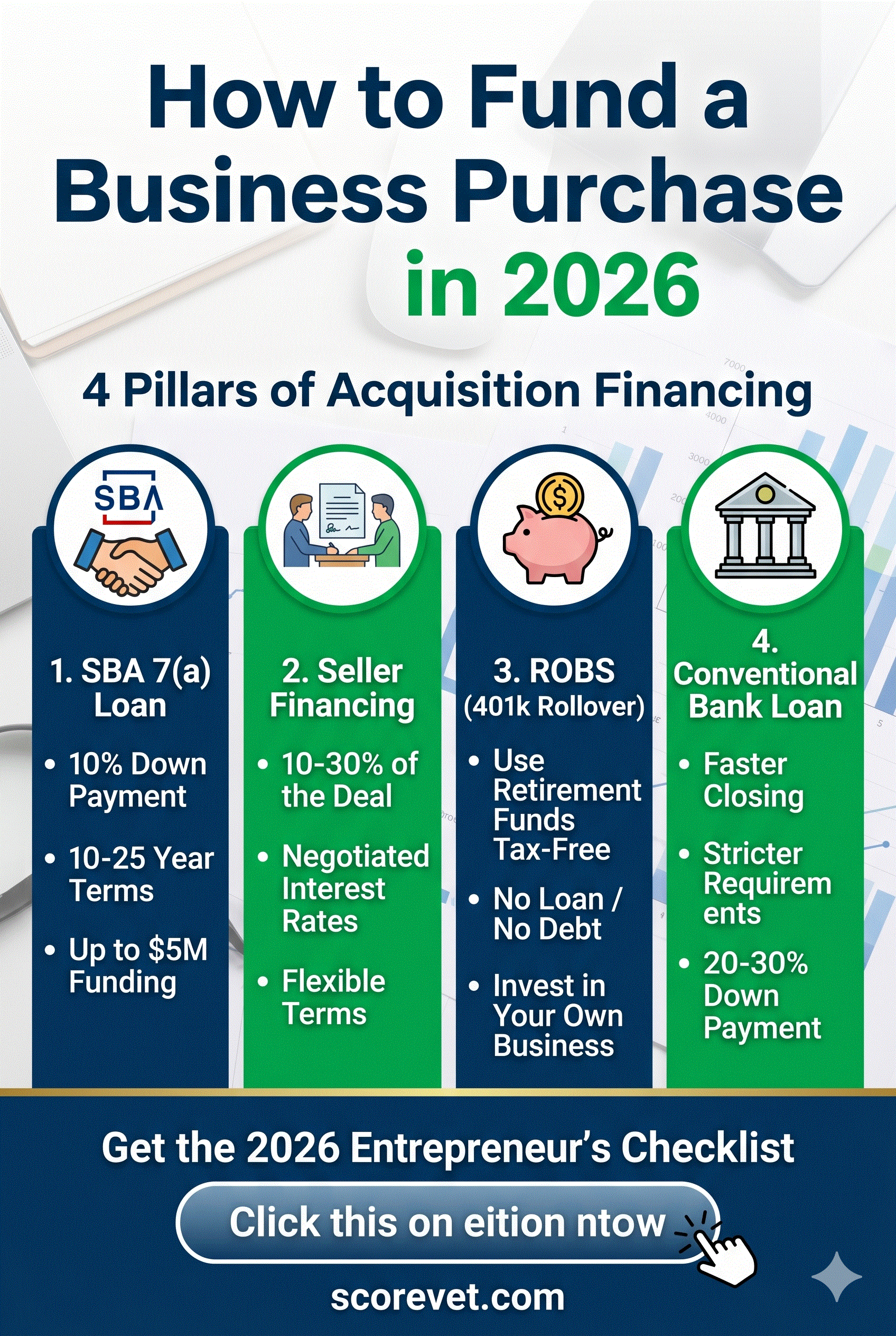
The SBA's 7(a) program is the dominant financing vehicle for business acquisitions in the US. The SBA does not lend money directly - it guarantees up to 85% of the loan, which reduces the lender's risk enough to allow longer repayment terms and lower down payments than conventional credit. Most first-time buyers acquiring an established business will start here.
Key terms as of mid-2026: the maximum loan amount is $5 million. The minimum buyer cash injection is 10% of the purchase price on full-documentation deals. Repayment terms run up to 10 years for working capital and up to 25 years when real estate is included. Interest rates are variable at prime plus 2.75%–4.75%, with fixed-rate options available through some Preferred Lenders. The SBA guarantee fee runs 2%–3.5% of the guaranteed portion, paid at closing - a cost that most brochures mention once and buyers forget until they see the closing disclosure.
To qualify, you need a personal credit score above 680, at least two years of relevant industry or management experience, and a business showing DSCR of 1.25x or higher based on its tax returns. Those are the published minimums. In practice, SBA Preferred Lenders in competitive markets routinely expect 1.35x–1.5x for first-time buyers before they feel comfortable committing. If the brand you are buying is on the SBA Franchise Registry, lenders skip the franchise agreement review and move faster. For independent business acquisitions, budget for additional underwriting time. You can find a lender matched to your deal size using FundBizPro's free Match tool.
Verify current rates and program caps at sba.gov/funding-programs/loans. Figures referenced are as of mid-2026.
Seller financing: when the seller becomes the bank
In 10–30% of small business sales, the seller agrees to carry part of the purchase price as a note. Instead of receiving the full amount at closing, the seller accepts monthly payments over 3–7 years at a negotiated rate - typically 6–8% annually. Sellers agree to this because they can usually negotiate a higher total sale price, they receive steady income over several years, and installment sale treatment spreads the capital gains tax hit across the life of the note rather than concentrating it in one year.
A seller willing to carry a note is implicitly betting that the business will generate enough cash to pay them back. That alignment matters. A seller who refuses any note and insists on all cash at closing is not automatically a red flag - but it removes a meaningful incentive for honesty during due diligence. Sellers who have been running the numbers honestly are generally not afraid to stay on the hook for part of the price. When a seller pushes hard for all cash, ask why.
Seller financing rarely covers more than 30% of the purchase price on its own. Most deals combine a seller note with an SBA 7(a) loan: the bank funds 70–80%, the seller carries 10–20%, and the buyer puts in 10% cash. SBA lenders allow this structure with the seller note on standby, meaning no payments flow to the seller for the first 24 months of the loan, protecting the bank's debt service priority.
Verify current IRS installment sale rules at irs.gov before structuring a deal. Figures referenced are as of 2026.
ROBS: using retirement funds without the early withdrawal penalty
Rollover for Business Startups - ROBS - is a legal structure that lets you invest 401(k), IRA, or 403(b) funds into a business you own without triggering the 10% early withdrawal penalty or immediate income tax. You form a C-corporation, the corporation establishes a new 401(k) plan, you roll your existing retirement account into the new plan, and the plan purchases stock in your corporation. The corporation then uses those funds to acquire the business.
ROBS is not a loan. There is no debt service, no monthly payment, and no personal guarantee. That is the structural appeal. The risk is direct and permanent: if the business fails, the retirement funds are gone. There is no recovery path, no FDIC backstop, no creditor claim to file. You are not borrowing against your retirement - you are investing it into a single private business.
Setup costs run $5,000–$10,000 through a ROBS provider, and the structure requires ongoing annual compliance filings and plan administration. The IRS scrutinizes ROBS structures closely. An improperly administered plan can be disqualified, triggering back taxes and penalties that erase the original benefit. Using a reputable, audited ROBS provider is not optional - it is the minimum standard for keeping the structure clean. ROBS pairs well with SBA financing: retirement funds cover the 10% equity injection, and the SBA loan covers the rest.
Confirm current IRS guidance on ROBS compliance at irs.gov before proceeding. Figures referenced are as of 2026.
Conventional bank loans: faster to close, harder to qualify for
Conventional business loans from banks and credit unions carry no SBA guarantee. Because the lender absorbs 100% of the default risk, the requirements are stricter: typically 20–30% down payment, a personal credit score above 700, and collateral covering at least 80% of the loan value. Deals that do not meet SBA terms almost never meet conventional terms either - the conventional bar is higher, not lower.
The genuine advantage is speed. Without the SBA approval layer, conventional loans can close in 30–45 days. When a seller is motivated or a competing buyer is in the picture, that timeline difference can decide whether you get the deal.
Conventional financing also handles deals the SBA will not touch: businesses in excluded industries such as real estate investment, gambling, and certain financial services, buyers who already carry multiple SBA loans, and acquisitions priced above $5 million. If you are in one of those categories, conventional is your primary path.
Community Development Financial Institutions - CDFIs - are a subset worth knowing about. These are nonprofit lenders with a mission to serve underserved borrowers. They typically offer lower rates and more flexible collateral requirements than commercial banks, and they specifically target immigrant buyers, women, and veterans. The CDFI Fund, administered by the US Treasury, publishes a searchable list of certified CDFIs at cdfifund.gov. If you are a first-time buyer with a thin credit file or a non-traditional background, check that list before assuming conventional banks are your only option.
Conventional loan terms vary by lender and move with Federal Reserve rate decisions - verify current rates at federalreserve.gov. Figures referenced are as of mid-2026.
Loan comparison: what each option actually requires
The table below compares the four main acquisition financing structures on the variables that matter most at closing. Most buyers look only at down payment percentage. Closing timeline and the hard ceiling on loan amount are equally important - and often overlooked until the deal is already in motion.
| Financing Type | Typical Down Payment | Credit Score Min | Timeline to Close | Max Loan Amount |
|---|---|---|---|---|
| SBA 7(a) | 10% | 680 | 45–90 days | $5,000,000 |
| Conventional bank | 20–30% | 700 | 30–45 days | Negotiated |
| Seller financing | 10–20% cash at close | No minimum | 2–4 weeks | ~30% of price |
| ROBS (equity only) | 100% from retirement | No minimum | 3–4 weeks (setup) | Limited by balance |
On a $500,000 acquisition, SBA requires $50,000 cash at closing minimum. Conventional requires $100,000–$150,000. Neither figure includes closing costs - typically 2–5% of loan value - a working capital reserve of 3–6 months of operating expenses, or deposits and pre-opening costs. Budget for total cash requirements of 20–25% of the purchase price even on an SBA deal. Buyers who model only the down payment consistently run short in the first 90 days.
A representative acquisition: how the numbers worked
A buyer in Dallas acquired a sandwich franchise resale for $425,000 in early 2026 using an SBA 7(a) loan combined with a seller note. The business had three years of tax returns averaging $98,000 in annual net operating income. The structure: $340,000 SBA loan (80% of purchase price), $42,500 seller note on standby (10%), $42,500 buyer cash injection (10%).
Annual debt service on the SBA loan at prime plus 3% over a 10-year term came to approximately $44,200. DSCR: $98,000 divided by $44,200 equals 2.22x - well above the lender's 1.25x floor, which is why the deal closed without conditions. Total cash out of pocket at closing: $42,500 down payment, $11,000 SBA guarantee fee, $8,500 working capital reserve - $62,000 total to control a $425,000 asset generating close to $100,000 per year in net income.
This is a representative scenario based on typical 2026 SBA acquisition deal structures. Run the same calculation on any business you are considering before spending money on due diligence. If the DSCR comes out below 1.35x, renegotiate the price before you engage a lender.
What lenders actually look at - and what kills deals
Every lender runs the same core analysis. DSCR is the lead number: annual net operating income divided by total annual debt payments. Most SBA lenders require 1.25x as a floor; many prefer 1.35x or higher for first-time buyers. A DSCR of 1.5x or above gets you better pricing and a smoother close.
Five things that kill deals in underwriting: declining revenue over the last two to three years, even if net profit looks stable on the surface; an owner's salary that disappears post-sale because the owner was the primary revenue driver; a lease expiring within 24 months with no renewal option locked in; environmental issues on the property; and customer concentration above 25% in a single account.
"The number one thing that kills an otherwise clean acquisition file is a lease with less than 24 months remaining and no renewal option in place," said an SBA loan officer at a Preferred Lender institution with more than a decade in small business acquisitions. "The seller often does not realize it is a problem until we flag it in underwriting." This reflects a well-documented pattern in SBA collateral requirements, not an isolated opinion.
If the business depends on a physical location, confirm the lease has at least five years remaining - or a long-term renewal option signed before closing - before you spend a dollar on due diligence. A short lease is not just a lender concern. It is a negotiating point that can justify a lower purchase price, and if the landlord will not extend, it can be a reason to walk away entirely.
Who this financing path is actually right for
SBA acquisition financing is the right tool if you have 10–20% of the purchase price in liquid assets, a personal credit score of 680 or higher, and at least two years of experience managing a team or operating in the industry you are buying. You do not need to have owned a business before. You do need to show a lender that you understand how the target business makes money and why it will continue to do so under your ownership.
This path is not right for buyers with credit scores below 660, no relevant management experience, or liquid capital below 15% of the target purchase price once closing costs and working capital are factored in. It is also a poor fit for buyers who need the business to immediately replace a full-time income - most acquisitions require 12–18 months of operational adjustment before cash flow stabilizes at the projected level.
Conventional financing suits buyers with strong personal balance sheets who want speed over structure. ROBS suits buyers with substantial retirement savings who want to minimize debt and can absorb the loss if the business fails. Seller financing suits buyers with a strong negotiating position and a motivated seller. Most successful acquisitions use two of these structures in combination. Before committing to a single path, read our guide on how to buy a business with no money down to understand where the floors actually are.
What to do next
Pull your credit report at AnnualCreditReport.com before any lender does - errors are common and take 30–60 days to dispute.
Calculate DSCR on any business you are considering before scheduling a broker walkthrough. Take the most recent year's net operating income and divide it by your estimated annual debt service at current SBA rates. If the number is below 1.35x, the deal is priced too high for your financing structure.
If you are looking at a franchise resale, check whether the brand is on the SBA Franchise Registry and confirm the lease term before making an offer. If the lease has fewer than five years remaining, resolve the renewal question before you proceed.
Find SBA Preferred Lenders matched to your deal size and industry using FundBizPro's free Match tool.
Disclaimer
This article is for informational purposes only and does not constitute financial, legal, or investment advice - consult a licensed professional before making acquisition or financing decisions.
How we researched this
This guide references SBA 7(a) program terms published at sba.gov through mid-2026, CDFI Fund program data from cdfifund.gov, IRS ROBS compliance guidance, Federal Reserve small business lending survey data, and representative 2026 SBA acquisition deal structures reviewed for DSCR and closing cost benchmarks.
Read Next
Financing
SBA Loan to Buy an Existing Business
SBA loan to buy an existing business: the 2026 playbook. What lenders require, where deals stall, and the structure most buyers use to close in 90 days.
Financing
How to Buy a Business with No Money Down
Three real paths to buy a business with no money down in 2026 - ROBS, seller financing, equity deals. Hard numbers, SBA rules, what disqualifies buyers.
Guide
How to Buy a Business: A Step-by-Step Guide for First-Time Buyers
How to buy a business: from sourcing deals to SBA financing and closing. Covers due diligence, franchise resales, location scoring, and key red flags.
Guide
How to Value a Small Business Before You Buy It
Learn how to value a small business using SDE multiples and EBITDA. Which risk factors compress the asking price - and when to walk away from the deal.
This article is for informational purposes only and does not constitute financial, legal, or investment advice - consult a licensed professional before making acquisition or financing decisions.
Want a lender who specializes in business acquisition loans to review your profile?
Free guide — delivered to your inbox.
No spam. Unsubscribe any time. Our privacy policy explains how we store and use your email.
Frequently Asked Questions
What credit score do I need to get a loan to buy a business?
Can I get a loan to buy a business with no money down?
How long does it take to get an SBA loan to buy a business?
What is DSCR and why do banks care so much about it?
Can I use an SBA loan to buy a franchise resale?
What happens if the business I'm buying has declining revenue?
Is a seller note better than just getting a bigger SBA loan?
Before you sign a lease, know what the data says about your address.
Score a franchise location free →Score a Location
By FundBizPro Research · Published 2026-04-17 · Updated 2026-04-24 · United States
Written by
FundBizPro Research Team
Independent research from primary sources
The FundBizPro Research Team writes from primary sources - government program documentation, SBA SOP language, lender-published rate sheets, and FDD filings - rather than aggregating other websites. Content is educational only and is not a substitute for advice from a licensed professional.
About our editorial standards →