SBA Loan to Buy an Existing Business
Updated
TL;DR — Key Facts
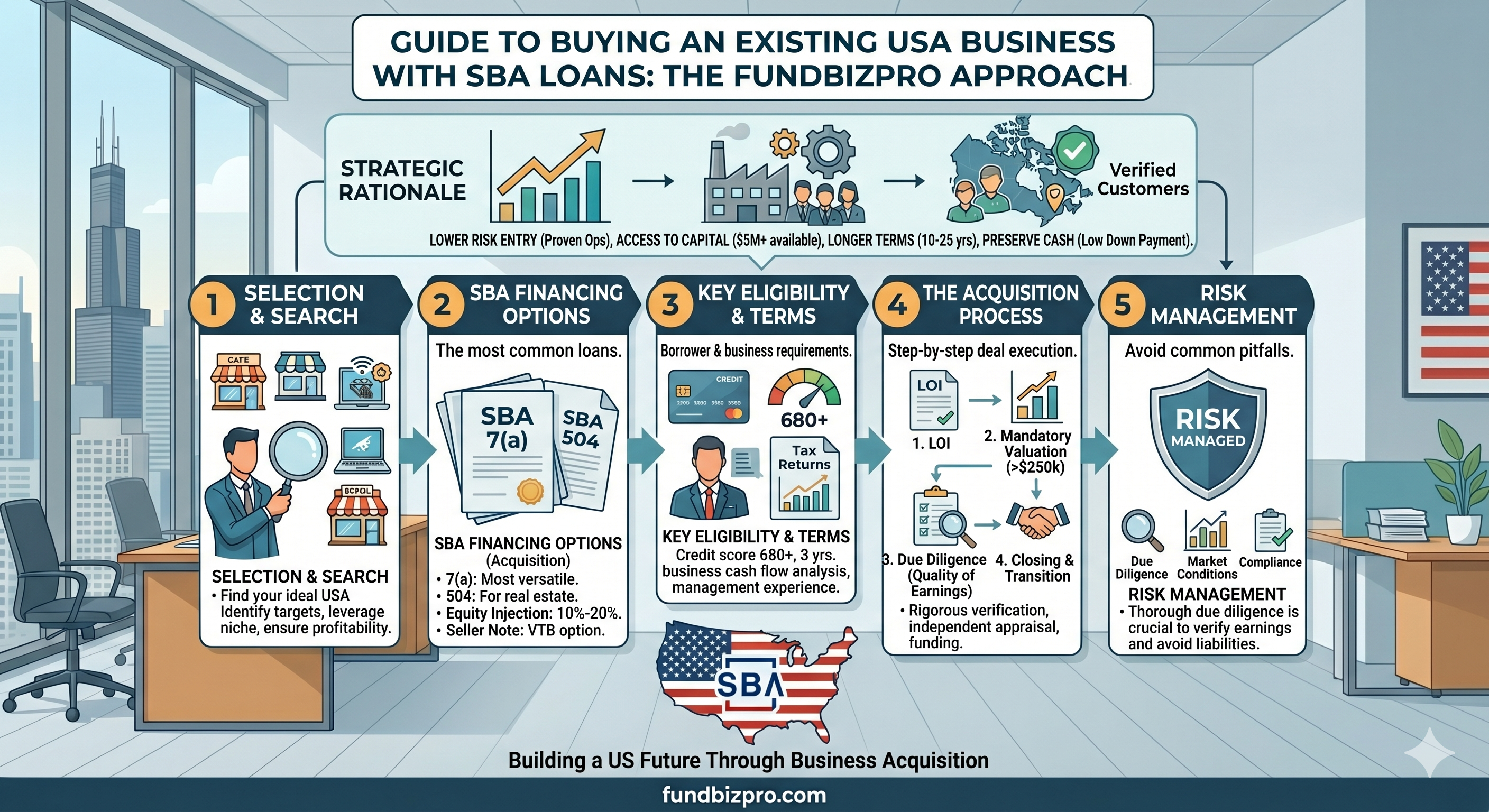
- →SBA 7(a) loans finance up to $5 million for existing-business acquisitions - the default path for deals where goodwill cannot secure a conventional bank loan.
- →The SBA requires a minimum 10% equity injection on acquisition loans - equity can be cash, a standby seller note, or ROBS funds from a retirement account.
- →Preferred Lenders (PLP status) approve SBA loans in-house without SBA review, cutting 2–3 weeks off a 90-day target close.
- →Lenders require a minimum DSCR of 1.25x - the business must generate $1.25 in cash flow for every $1 of annual debt service after acquisition.
- →Independent business valuation required for any acquisition over $250,000 - costs $2,500–$5,000 and takes 2–3 weeks; the SBA lends only up to the valuation number.
Why SBA 7(a) dominates existing-business acquisitions
Conventional bank loans underwrite against collateral. Existing-business acquisitions are light on hard collateral - goodwill, customer relationships, and a trained team do not secure a loan the way real estate or equipment does. That is why the SBA guarantee program exists: it gives lenders 75–85% government backing on the loan, which unlocks the deal structure conventional lenders will not touch.
For a typical existing-business acquisition - say, a $1.2M purchase of a 15-year-old service business with $300K EBITDA - the deal splits like this: $1,080,000 SBA 7(a) loan, $120,000 buyer equity injection. The conventional equivalent would require $300K+ down and 100% collateral coverage. Neither of which is available in most small business acquisitions.
This is why 7(a) is not just "one option." For existing-business deals under $5M, it is the default path.
SBA microloans exist at the other end of the spectrum - up to $50,000 through nonprofit intermediary lenders like Accion Opportunity Fund and Grameen America. They serve early-stage startups that cannot qualify for 7(a) amounts. They are not used for acquisitions.
The 10% rule - and why most buyers misunderstand it
SBA policy requires a minimum 10% equity injection on business acquisition loans. Buyers often assume this means 10% cash from their bank account. It does not.
The 10% can be structured three ways: - 100% buyer cash (simplest, fastest approval) - 5% buyer cash + 5% seller note on full standby (seller receives no payments for the first 24 months) - ROBS (Rollover for Business Startups): buyers with $50,000 or more in a 401(k) or IRA can roll those funds into the acquisition as equity - no taxable withdrawal, no debt service on that portion
What is NOT counted as equity: a seller note that is not on full standby, a non-SBA second loan, deferred earnouts tied to performance. The SBA wants first-loss capital with no competing claims in the first 24 months.
For buyers with limited savings, the 5% cash + 5% standby seller note structure is the most common real-world path to a 10% deal. It requires the seller's cooperation, and motivated sellers agree more often than you might expect - especially in deals where the business has been on the market for more than 6 months.
Preferred Lenders vs standard SBA lenders
Not every SBA lender is equal. The SBA designates top lenders as "Preferred Lenders" (PLP status), which gives them delegated authority to approve loans without sending the file to the SBA for review. This matters.
At a standard (non-PLP) lender, your complete file goes to the SBA after the lender approves it internally. The SBA review takes 10–20 business days on top of everything else. At a PLP lender, the lender's credit committee approval is the final approval - no second review, no second queue.
For a 90-day target closing, using a PLP lender is the difference between hitting it and missing it. Top PLP lenders for acquisitions include Live Oak Bank, Celtic Bank, Newtek Business Services, Byline Bank, and several regional community banks that specialize in SBA.
Ask directly in your first call: "Are you a Preferred Lender?" If the answer is no, and your deal has any time pressure, keep looking.
The business valuation requirement
For any SBA acquisition loan over $250,000 where the purchase price exceeds the book value of the assets, the SBA requires an independent business valuation. This is a hard requirement, not a guideline.
The valuation must be performed by a qualified third party - a certified business appraiser, an accredited CPA with business valuation designation (ABV or CVA), or an industry expert the lender approves. The seller's asking price is not a valuation. The broker's pitch deck is not a valuation. A napkin calculation is not a valuation.
Valuations cost $2,500–$5,000 and take 2–3 weeks. The lender orders it; the buyer typically pays. If the valuation comes in below the purchase price, the SBA will only lend against the valuation number - not the higher contract price. Any gap must be covered by additional buyer equity or a reduced purchase price.
This is where deals stall or die. Smart buyers write the purchase agreement with a financing contingency that allows renegotiation if the valuation comes in low.
Documentation the lender will ask for on day one
The paperwork is predictable. Having it ready when you submit the application shaves 2–4 weeks off the timeline.
Buyer documentation: - Personal financial statement (SBA Form 413) - 3 years of personal tax returns - Resume showing relevant management or industry experience - Credit report (lender pulls; you verify it is clean beforehand) - Source of equity injection documentation (bank statements, rollover papers, gift letter)
Business documentation (the seller provides - confirm they can): - 3 years of business tax returns - 3 years of profit and loss statements - Current balance sheet and accounts receivable/payable aging - Copy of the lease - Customer concentration report (top 10 customers as % of revenue) - List of all equipment with ages and values - Franchise agreement (if applicable)
Deal documentation: - Executed Letter of Intent or Purchase Agreement - Business valuation (ordered after LOI) - Projections (3 years post-acquisition, month-by-month for year 1)
The #1 reason SBA loans take longer than they should: seller financial records that are incomplete, informal, or delayed. Vet the seller's bookkeeping before you go under contract.
The timeline in realistic weeks
Here is the actual schedule for a well-run SBA acquisition loan at a PLP lender:
Week 1: Application submitted, lender pulls credit, initial financial review Week 2: Lender orders business valuation, requests additional documentation Weeks 3–5: Valuation in progress, lender processes file, environmental review ordered if real estate is involved Week 6: Credit committee review Week 7: Approval issued (or conditional approval with stipulations) Weeks 8–9: Legal documentation drafted, title work, lease assignment negotiation Week 10–11: Final conditions cleared, closing scheduled Week 12: Funding
That is 12 weeks, clean. Most deals run longer because one or more of these steps gets delayed: the valuation comes back late, the landlord drags on lease assignment, the seller is slow providing updated financials, or the buyer's equity source needs additional documentation.
Start the conversation with your lender before you sign the LOI, not after. The lender can pre-qualify your side of the file while you are negotiating the deal itself, cutting 3–4 weeks off the total timeline.
What kills SBA acquisition deals
In rough order of frequency, here is what turns a yes into a no:
- DSCR below 1.25x. SBA lenders require the business to generate at least $1.25 in net operating income for every $1 of annual debt service after your acquisition closes - that is the 1.25x Debt Service Coverage Ratio floor. Declining revenue is the most common path to breaking it: the lender models continued deterioration and the numbers stop working. Flat revenue is fine. Declining is a dealbreaker.
- Owner dependence. If the seller is the top salesperson, the key technical expert, or the primary customer relationship, the lender will ask how you replace them. No good answer = no loan.
- Short lease. The lender wants the lease term to match or exceed the loan term. On a 10-year loan, 10 years of lease (including firm renewal options) is the expectation. A 3-year lease on a business tied to its location is a dealbreaker.
- Customer concentration. If any single customer is more than 25% of revenue, the lender treats that customer as a risk. Over 40% and most lenders will decline.
- Environmental contamination. Any business with real estate gets a Phase I environmental assessment. Contaminated sites (gas stations, dry cleaners, auto repair) add 60+ days, cost $10,000+ in additional testing, and can kill the deal entirely.
None of these are hidden. All are visible in the first 30 days of due diligence. Walk away before you are $20,000 into legal and valuation fees, not after.
Read Next
Financing
How to Buy a Business with No Money Down
Three real paths to buy a business with no money down in 2026 - ROBS, seller financing, equity deals. Hard numbers, SBA rules, what disqualifies buyers.
Guide
Buy a Small Business: A First-Time Buyer's Playbook
The complete guide to buy a small business: SBA loans, due diligence, valuation multiples, seller financing, and how to score any location in minutes.
Guide
How to Buy a Business: A Step-by-Step Guide for First-Time Buyers
How to buy a business: from sourcing deals to SBA financing and closing. Covers due diligence, franchise resales, location scoring, and key red flags.
Financing
SBA 7(a) Loan Explained: Requirements, Rates, and the Real Timeline
The small business administration 7(a) loan goes up to $5 million. Here's what rates look like, who qualifies, and how to cut the 60–90 day timeline.
This article is for informational purposes only and does not constitute financial, legal, or investment advice - consult a licensed professional before making acquisition or financing decisions.
Want a Preferred SBA Lender to review your existing-business deal before you sign the LOI?
Free guide — delivered to your inbox.
No spam. Unsubscribe any time. Our privacy policy explains how we store and use your email.
Frequently Asked Questions
Can I use an SBA loan to buy just part of a business?
What credit score do I need for an SBA acquisition loan?
Do I have to personally guarantee the SBA loan?
Can my SBA loan include working capital on top of the purchase price?
What happens if the business underperforms after I buy it?
Can I combine an SBA 7(a) loan with a 504 loan?
Do franchise acquisitions use the same SBA process?
Before you sign a lease, know what the data says about your address.
Score a franchise location free →Score a Location
By FundBizPro Research · Published 2026-04-18 · Updated 2026-05-01 · United States
Written by
FundBizPro Research Team
Independent research from primary sources
The FundBizPro Research Team writes from primary sources - government program documentation, SBA SOP language, lender-published rate sheets, and FDD filings - rather than aggregating other websites. Content is educational only and is not a substitute for advice from a licensed professional.
About our editorial standards →