Buy a Small Business: A First-Time Buyer's Playbook
Updated
TL;DR — Key Facts
- →SBA 7(a) loans fund acquisitions up to $5 million at a minimum 10% down payment — even for first-time buyers with no prior ownership history.
- →Lenders require a Debt Service Coverage Ratio of 1.25x — the business must generate $1.25 for every $1.00 of annual debt payments to qualify.
- →ROBS (Rollover for Business Startups) lets buyers use $50,000 or more from a qualifying retirement account as the SBA equity injection — no taxable distribution.
- →SBA microloans go up to $50,000 through nonprofit intermediary lenders — useful for working capital gaps the main acquisition loan does not cover.
- →Customer concentration above 25% of revenue and lease expiration under 2 years are the two most common post-close surprises in Main Street acquisitions.
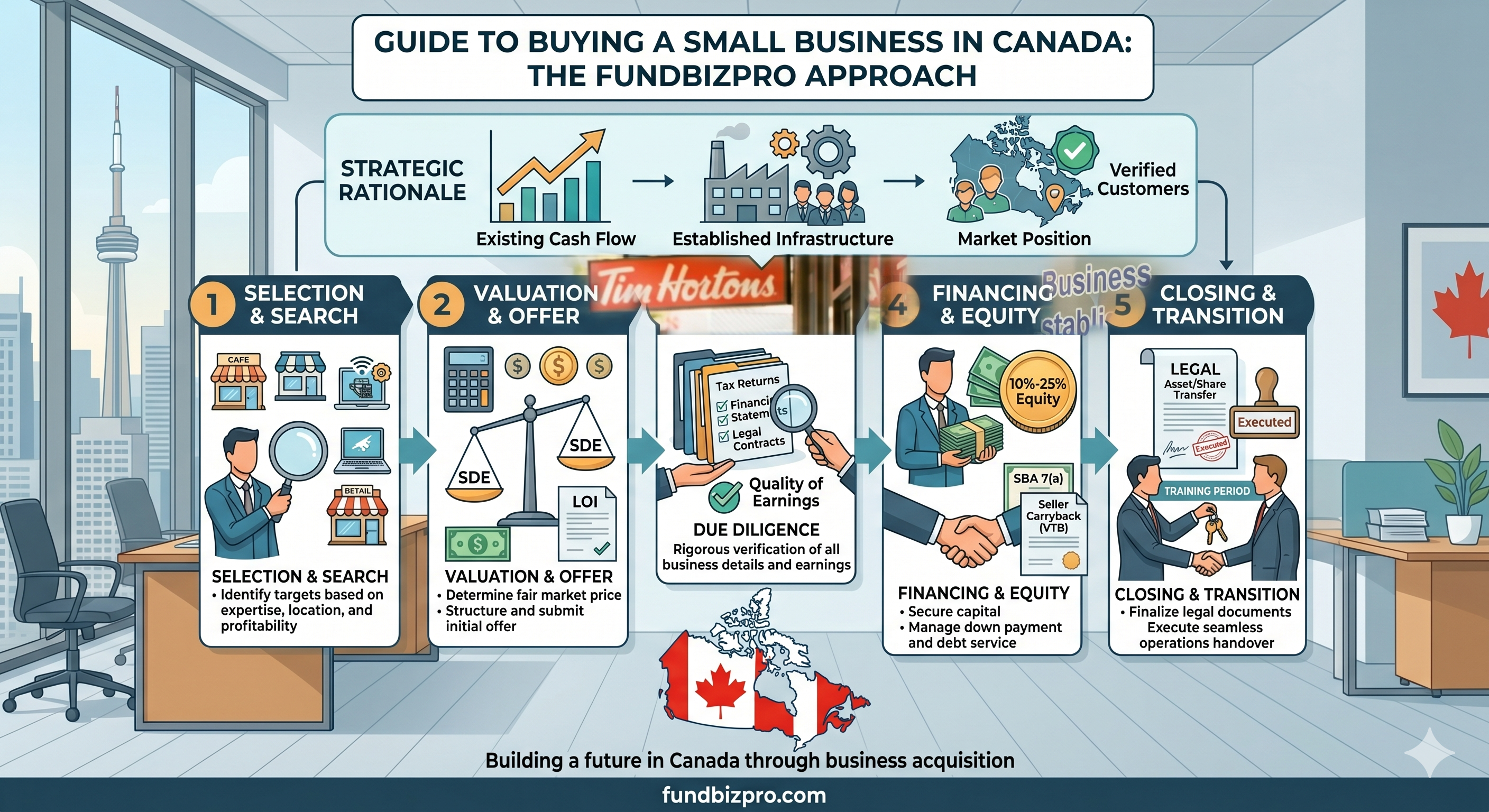
What "Buying a Small Business" Actually Means
"Small business" covers an enormous range — from a $50,000 lawn care route to a $5 million multi-unit franchise operation. For this guide, we are focused on the Main Street sweet spot: businesses with $100,000–$1,000,000 in annual owner earnings, typically financed with an SBA 7(a) loan.
These are businesses with 2–20 employees, enough revenue to pay you a salary and service your acquisition debt, and an owner-operated structure where you are the primary decision-maker. They include franchise units, independent restaurants, service businesses, retail shops, B2B service companies, and home-based service businesses. The process of buying is similar across all of these categories. The differences are in how you evaluate industry-specific risks — and which signals matter most for each type of location.
Before You Search: The Three Decisions That Shape Everything
Decision 1: Franchise or independent?
Franchises offer brand recognition, training, a proven system, and an ongoing support relationship with the franchisor. They cost more (franchise fee + royalties) but reduce operational risk for first-time buyers. Independent businesses are cheaper on a per-dollar-of-earnings basis but require more experience to run.
If you've never owned a business and don't have deep industry experience, lean toward franchises. If you have 10 years in a specific industry, buying an existing independent in that industry often makes more sense.
Decision 2: What industry?
Think about your lifestyle, not just your financial return. A food service business will consume nights and weekends. A B2B service business runs 9–5. A gym franchise requires early morning energy. A cleaning service is physically demanding. Choose an industry you can see yourself in for 5–10 years - that's roughly how long you'll need to work to recoup your investment.
Decision 3: How much can you inject?
Calculate your total injectable capital: liquid savings, plus eligible retirement funds if you have $50,000 or more in a qualifying account — a ROBS (Rollover for Business Startups) arrangement lets you roll those funds into a C-corp that acquires the business, making them count as the SBA equity injection without triggering a taxable distribution. SBA loans require at minimum 10% down. At 10%, here is your buying range:
| Injectable Capital | Business Price Range (at 10% injection) |
|---|---|
| $25,000 | Up to $250,000 |
| $50,000 | Up to $500,000 |
| $100,000 | Up to $1,000,000 |
| $200,000 | Up to $2,000,000 |
Finding Small Businesses for Sale
Online marketplaces. BizBuySell.com is the largest and most active marketplace for Main Street businesses. BusinessBroker.net is the second largest. Both aggregate listings from brokers across the country. Expect to see 10,000+ active listings nationally at any time.
Local business brokers. Business brokers represent sellers (they're paid by sellers, not you). But they control off-market inventory - businesses that will never appear on BizBuySell because the seller wants confidentiality. Building relationships with 3–5 local brokers in your target area is often more productive than spending 12 hours a week on listing sites.
Direct outreach. Many small business owners are thinking about exit but haven't listed yet. A direct letter (physical mail, not email) expressing interest in acquiring their business - especially to owners who've been operating for 15+ years - generates surprising responses. This takes more effort but produces less competition.
Franchise systems. If you're interested in a specific franchise brand, their franchise development team can show you: (a) available territories for new units, and (b) existing units being sold by outgoing franchisees. Franchise resales are often the fastest path to cash flow because the location is already proven.
Your professional network. Accountants, attorneys, and lenders who work with small businesses often know before the public does when an owner is thinking about selling. If you have any of these relationships, use them.
Reading the Financials: What Actually Matters
When a broker sends you a Confidential Business Review (CBR) or Offering Memorandum, here's what to focus on:
Seller's Discretionary Earnings (SDE). The bottom-line number every Main Street deal is priced on. SDE = net income + owner salary + owner benefits + personal expenses run through the business + non-cash charges (depreciation, amortization). This represents what a working owner-operator actually takes home.
Revenue trend. Is the top line growing, flat, or declining? Growth supports the asking price. Decline requires explanation - and usually price reduction.
Gross margin. Varies enormously by industry. A service business should run 60–80% gross margin. A restaurant runs 60–70%. A retail business runs 40–60%. If gross margin is below industry norms, find out why.
Owner involvement. How many hours per week does the current owner work? If the owner works 70 hours/week and is paying themselves $80,000, that's not a great business - it's a job that doesn't pay well. Adjust the SDE for market-rate labor to get a more honest picture.
Red flags in financials: - Revenue that varies dramatically year-over-year without explanation - P&L expenses that don't match the tax returns - Accounts receivable that are consistently 90+ days old - Inventory listed at cost but aging (retail businesses) - Lease expense dramatically below market (landlord may reset at renewal)
The SBA Loan: How to Finance a Small Business Purchase
The SBA 7(a) loan is the workhorse of small business acquisitions. It is not a government loan — it is a bank loan with an SBA guarantee, which allows banks to offer longer terms and lower down payments than they otherwise could. The maximum loan amount is $5,000,000, with a minimum down payment of 10–20% of the purchase price. Interest rates run at Prime plus 2.75%, and repayment terms are 10 years for business-only acquisitions or 25 years when real estate is included.
The central underwriting test is cash flow. Lenders require a Debt Service Coverage Ratio of at least 1.25x — meaning the business must generate $1.25 in net operating income for every $1.00 of annual debt payments. If the business's verified earnings do not support that ratio at the requested loan amount, the deal does not close regardless of your credit or experience. Personal credit of 650 or above is the typical threshold for SBA approval; 700 or above opens more lender options.
SBA Preferred Lender Program (PLP) lenders can approve loans internally — faster processing, no SBA submission wait. Ask any lender directly: "Are you a PLP lender?" For franchise buyers, confirm whether your brand is on the SBA Franchise Registry — registry brands receive expedited review because the franchise agreement is pre-approved, shortening the timeline by 2–4 weeks.
For smaller acquisitions or working capital gaps the main SBA loan does not cover, SBA microloans go up to $50,000 through nonprofit intermediary lenders. There is no minimum revenue requirement. They are not sized to fund a full acquisition, but they can bridge the capital needs your primary financing leaves uncovered.
Due Diligence: The Checklist That Protects Your Money
Due diligence is your window — typically 30–60 days after signing a Letter of Intent — to verify what the seller has represented. Most deals survive it. The ones that do not usually surface a problem that was there all along.
Financial verification starts with bank statements. Request 12 months for all business accounts and cross-reference deposits against the P&L line by line. Then pull three years of tax returns and compare them to the P&Ls for the same periods. Every discrepancy should have an explanation: add-backs (personal expenses run through the business) are expected and legitimate, but each one needs a receipt or payroll record to be accepted by an SBA lender. Pull the accounts receivable aging report and check for liabilities, loans, or liens that might survive the sale.
Operational verification covers the customer base, staff, and physical assets. Get the top 20 customers by revenue and their contract status — ask which relationships belong to the business and which belong to the owner. Review supplier contracts for pricing terms and whether those terms transfer. Check equipment maintenance records; deferred maintenance becomes your capital expenditure in year one. Confirm that intellectual property (domain names, social accounts, trademarks) is included in the sale and properly transferred.
Legal due diligence has three items that most often affect closing price: lease review (remaining term, renewal options, landlord assignment consent, and rent escalation clauses — a lease with under two years remaining and no renewal option is a negotiating point, not a dealbreaker), lien searches on all business assets, and any pending or threatened litigation including regulatory compliance. For industrial or food-service locations, add an environmental compliance check.
For franchise acquisitions, review the full Franchise Disclosure Document (FDD) — all 23 items, with a franchise attorney — and call 10–15 existing franchisees from the Item 20 list. Ask them what they wish they had known before buying, whether they would do it again, and how responsive the franchisor is when problems arise. The franchise agreement itself — term, renewal, transfer fees, and exit rights — also needs attorney review before you sign.
Location: The Variable Most Buyers Underweight
For any business with a physical location, the address is often the single most important driver of long-term revenue. Most buyers evaluate it with a drive-by and a gut feeling. Neither is sufficient.
What actually predicts whether a location works is a set of signals most buyers do not have easy access to: trade area demographics (is your target customer living, working, or passing through?), daytime population within half a mile (critical for lunch-driven businesses where office workers matter more than residential density), competitive density and ratings within the trade area, vehicular and pedestrian traffic at the specific intersection, transit proximity in urban markets, and for franchises, cannibalization risk from nearby same-brand units.
FundBizPro scores any commercial address on all of these signals and returns a 1–10 location score in about 60 seconds. A score of 7 or above indicates a viable site. Under 5 means specific risks need to be addressed before you commit to a lease assignment.
Run it before you sign your LOI. The franchisor approved this location for the system — not necessarily for your profitability at your cost structure. Your location score is an independent second opinion that neither the seller nor the franchisor is providing.
Common Mistakes First-Time Buyers Make
The most expensive mistake first-time buyers make is emotional investment too early. Once you are attached to a specific business, red flags become rationalizations. The discipline to keep evaluating other businesses even while you are in due diligence separates buyers who close good deals from those who close deals they later regret.
Add-backs without documentation is the second mistake. Seller's adjusted earnings are legitimate — owners run personal expenses through businesses and those should be added back to calculate real earnings. But every add-back needs a receipt, a payroll record, or a specific tax line. If it cannot be explained to an SBA lender, it does not count toward your loan and it does not count toward your valuation.
Ignoring the lease is the third, and often the costliest. A lease with 18 months remaining and no renewal option is a real risk. You can build a thriving business and face a landlord who will not renew — or renews at three times the previous rate. Get a lease attorney to review the assignment before you close, not after.
Underestimating working capital is pervasive. The SBA loan covers the purchase price. After closing, you still need capital for seasonal cash flow gaps, unexpected equipment failures, slower-than-expected revenue ramp, and initial marketing. Budget 3–6 months of operating expenses as a post-close reserve beyond your down payment.
For franchise resales, skipping franchisee validation calls is a specific failure. Item 20 of the FDD lists every current and former franchisee. Call 10–15 before you buy. The questions that matter: What do you wish you had known? Would you do it again? How responsive is the franchisor when something goes wrong? Those answers are often very different from what the franchise development team tells you.
Read Next
Guide
How to Buy a Business: A Step-by-Step Guide for First-Time Buyers
How to buy a business: from sourcing deals to SBA financing and closing. Covers due diligence, franchise resales, location scoring, and key red flags.
Financing
How to Get a Business Loan to Buy an Existing Business
Get a business loan to buy an existing business in 2026: SBA 7(a) structure, DSCR minimums, the full document checklist, and timeline from offer to close.
Financing
How to Buy an Existing Business with No Money Down
How to buy an existing business with no money: ROBS, SBA standby notes, seller financing, and earnout. The real tradeoffs and what lenders require in 2026.
Guide
How to Buy an Existing Business (Complete Guide)
How to buy an existing business in 2026: deal sourcing, due diligence, valuation, and SBA financing. Step-by-step process from first search to closing day.
Your Next Step
This article is for informational purposes only and does not constitute financial, legal, or investment advice - consult a licensed professional before making acquisition or financing decisions.
Score any commercial address before you buy.
Free guide — delivered to your inbox.
No spam. Unsubscribe any time. Our privacy policy explains how we store and use your email.
Frequently Asked Questions
What is the best small business to buy for a first-time owner?
How do you find small businesses for sale near me?
What credit score do you need to buy a small business?
Can you buy a business with no experience?
What is seller financing and should I look for it?
How much does it cost to buy a franchise vs. an independent business?
Work out what the business is actually worth on SDE before you negotiate a price.
Value the business before you offer →Score a Location
By FundBizPro Editorial · Published 2025-09-25 · Updated 2026-05-21 · United States
Written by
FundBizPro Editorial Team
Independent research from FDD filings and primary sources
The FundBizPro Editorial Team covers North American franchise costs, FDD analysis, site selection, and acquisition financing. Articles draw on current FDD filings and primary industry sources and are reviewed before publication. Content is educational only and is not a substitute for advice from a licensed professional.
About our editorial standards →