How to Get a Business Loan to Buy an Existing Business
Updated
TL;DR — Key Facts
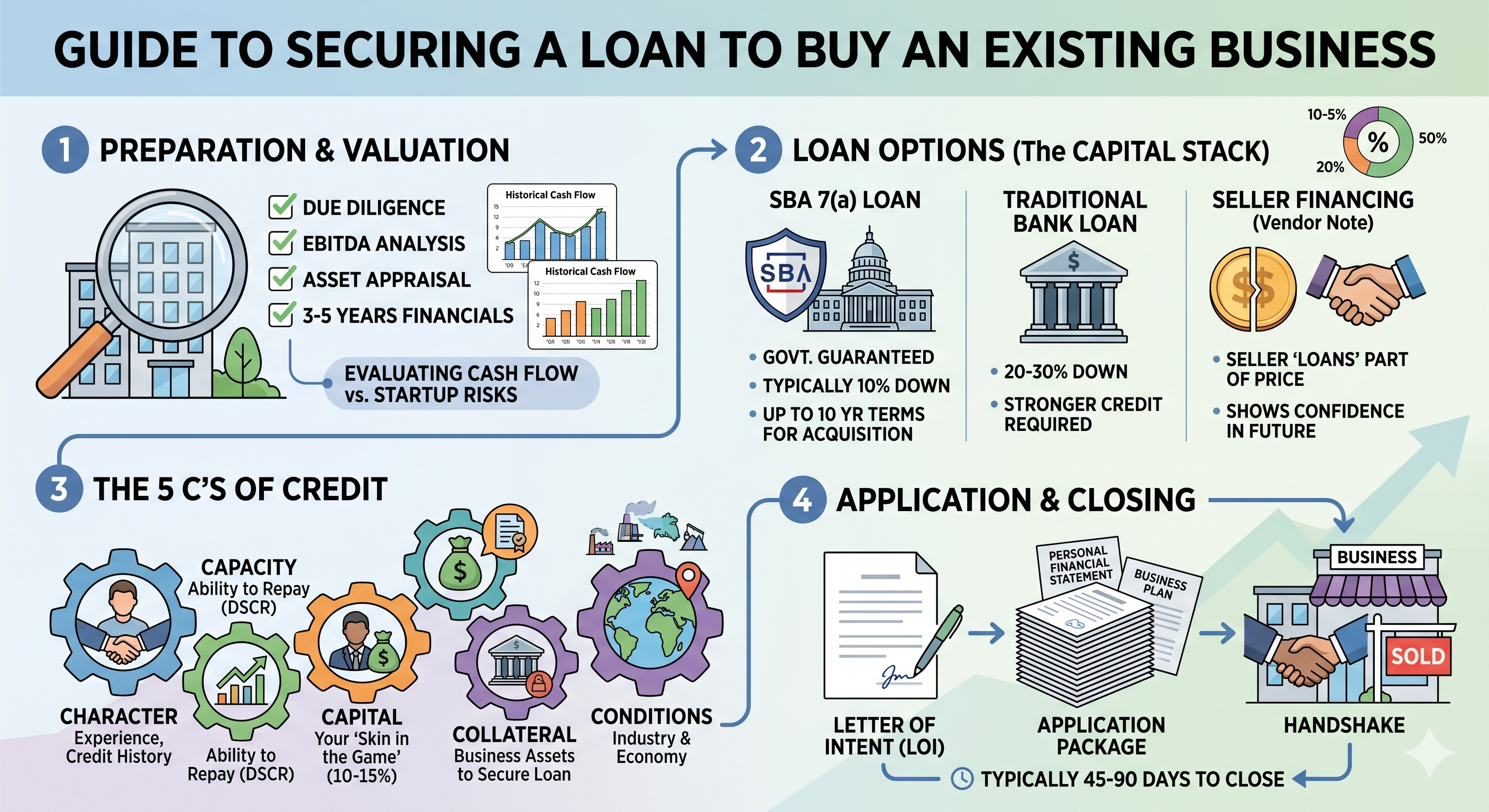
- →SBA 7(a) is the most common path: 10% down, up to $5M, 45–90 days to close.
- →Lenders require DSCR of 1.25x - the business must earn $1.25 for every $1.00 in annual debt payments.
- →You need 3 years of business tax returns, a current P&L, asset list, and a copy of the lease.
- →Declining revenue over the past 2–3 years is the most common reason existing business loans fail.
- →Seller financing can cover 10–20% of the price, reducing what you need from a bank.
Why "existing business" loans are a different conversation
The immigrant couples walking the floor at the April 2026 Montreal Franchise Expo weren't asking about franchises in the abstract - they were asking how to finance a specific business they had already found. That is the audience for this article: buyers who have identified a target and need to understand the financing path from offer to close.
Loans for existing businesses differ from startup loans in one critical way: there is revenue history to underwrite. A lender can look at three years of tax returns, calculate whether the business generates enough cash flow to service the debt, and make a decision grounded in real numbers rather than projections. That makes acquisition financing significantly more accessible - and more predictable - than financing a new venture.
The tradeoff is that the business's history becomes your strongest asset or your biggest liability. A business with three years of clean, growing revenue gets a fast approval and a low rate. A business with declining revenue - even profitable declining revenue - will face questions the seller may not have easy answers for.
Step 1: Confirm the business qualifies before you spend money on due diligence
Before hiring a business attorney or a CPA to review the books, run the basic lender math yourself. Ask the seller for the last three years of tax returns and a current Profit & Loss statement. Calculate the Seller's Discretionary Earnings (SDE): net profit plus the owner's salary plus any personal expenses run through the business.
Then estimate your debt service: if you're borrowing $400,000 at 8.5% over 10 years, your annual payments are approximately $59,500. Divide the SDE by $59,500. If the result is below 1.25, a lender will likely decline the deal at that purchase price. You either need a lower price, a larger down payment, or a different structure.
This math takes 20 minutes and can save you $3,000–$5,000 in due diligence costs on a deal that was never going to be financed.
Step 2: Assemble your document package
Lenders for existing business acquisitions require documentation from both the buyer and the business being purchased. Incomplete packages are the most common cause of timeline delays - not lender slowness.
From the business (seller provides):
| Document | Why lenders need it |
|---|---|
| 3 years of business tax returns | Cash flow verification and trend analysis |
| Current Profit & Loss statement | YTD performance vs. historical |
| Balance sheet | Asset and liability snapshot |
| List of assets to be transferred | Determines collateral value |
| Copy of the current lease | Confirms tenure and renewal options |
| Any existing loan or equipment financing | Reveals off-P&L liabilities |
From you (buyer provides):
| Document | Why lenders need it |
|---|---|
| 3 years of personal tax returns | Verifies personal income and debt |
| Personal financial statement | Net worth and liquidity |
| Resume or business biography | Demonstrates relevant experience |
| Credit authorization | Lender pulls credit report |
Start collecting these before you make an offer. Sellers who want to close quickly are more cooperative with buyers who have their paperwork ready.
Step 3: Choose the right loan structure
For most existing business acquisitions under $5M, SBA 7(a) is the starting point. The SBA guarantees up to 85% of the loan, which lets participating lenders offer 10% down payment versus the 20–30% required for conventional loans. For a $500,000 acquisition, that is the difference between $50,000 and $100,000–$150,000 out of pocket at closing.
SBA 7(a) key terms for Q2 2026: maximum loan of $5,000,000, down payment of 10% for full-documentation deals, terms of up to 10 years for business acquisitions, variable rate of prime plus 2.75–4.75% (prime was approximately 8.5% as of April 2026, putting effective rates at 11.25–13.25%). For deals where the seller agrees to carry a note (seller financing), SBA allows the seller note to be on standby - no payments to the seller for the first two years of the loan. Verify current rate caps at sba.gov/funding-programs/loans/7a-loans.
For deals above $5M or for buyers who need to close in under 30 days, conventional bank financing or private lending are alternatives - but both require more cash at closing and carry stricter credit requirements. See the SBA vs. Business Loan vs. Private Lender comparison for the full breakdown.
Two equity sources pair well with SBA 7(a): ROBS (Rollover for Business Startups) lets buyers invest $50,000 or more from a qualified retirement account as the equity injection - the funds become equity in the new entity rather than a taxable distribution. SBA microloans are a separate program capped at $50,000, designed for early-stage startups and working capital, not the larger equity positions most acquisitions require.
A real acquisition: how one buyer structured the deal
In late 2025, a buyer in Columbus, Ohio acquired a residential cleaning franchise resale for $285,000. The business had operated for six years and generated $62,000 in Seller's Discretionary Earnings (SDE) in the most recent tax year - down slightly from $67,000 the prior year, a dip the seller attributed to losing one commercial contract.
The buyer used SBA 7(a) financing through a Preferred Lender: $256,500 borrowed at 10% down ($28,500 in cash at closing), 10-year term, prime plus 2.75%. Annual debt service: approximately $35,200. DSCR on the $62,000 SDE: 1.76x - comfortably above the 1.25x minimum.
The declining revenue year was disclosed upfront with documentation of the lost contract. The lender accepted the explanation. Closing took 51 days from application. Total cash out of pocket at closing - down payment, closing costs, and a 60-day working capital reserve - was $54,000.
The lesson: a single down year is not a deal-killer if you can document why it happened and show the underlying business is sound.
Step 4: Apply and move through underwriting
Once you have your document package and have chosen a lender, the formal application process begins. SBA Preferred Lenders - banks and credit unions approved to make SBA lending decisions without waiting for SBA review - are the fastest path. Use the SBA's Lender Match tool at lendermatch.sba.gov or ask your business broker to recommend one with franchise and acquisition experience.
Underwriting for existing business acquisitions typically focuses on four things: DSCR (does the business cash flow support the debt?), collateral (what assets secure the loan?), buyer experience (do you have relevant background?), and business trends (is revenue growing or declining?).
One number lenders look at that most buyers miss: customer concentration. Per published SBA underwriting guidance, any single customer representing more than 25% of total revenue is flagged as a concentration risk. Above 40%, most lenders decline or require contractual mitigation - multi-year customer agreements or key-person insurance covering the revenue relationship. Get a revenue-by-customer breakdown before you submit the application.
Step 5: Handle the lease and close
The lease kills more acquisition deals than any other single factor. Lenders will not fund a business acquisition if the lease has less than the loan term remaining - typically 10 years for SBA deals. If the business has 3 years left on its lease with no renewal option, you need the landlord to extend or renew before the lender will commit.
This takes time. Landlords are not parties to the transaction and have no urgency to move quickly. Budget 30–60 days for lease negotiations and start them early in the process - before you have spent $5,000 on attorney and CPA fees.
For franchise resales, there is an additional step: franchisor transfer approval. The brand must approve you as the new franchisee, which requires meeting their net worth and liquidity minimums and completing their standard background process. Transfer approval adds 30–60 days and a transfer fee, typically $5,000–$20,000.
Once underwriting clears and the lease and transfer approvals are in place, closing takes 1–3 days. The SBA closing package includes a promissory note, a security agreement, and a personal guarantee from every owner holding 20% or more of the business.
What kills existing business acquisition loans
Declining revenue is the most common deal-killer in underwriting. A business that earned $300,000 in 2023, $260,000 in 2024, and $230,000 in 2025 raises a direct question: why would that trend reverse under new ownership? If you cannot document a specific cause - a lost contract, a one-time expense, a lease renegotiation - lenders will reduce the loan amount, raise the rate, or decline. Flat revenue is manageable. Declining revenue without a documented explanation is not.
A short lease is the second most common problem. Most SBA lenders require the lease term to match or exceed the loan term - typically 10 years, including renewal options. A business with three years left on its lease and no renewal option is effectively unfinanceable until the landlord acts, which can take 30–60 days and is not guaranteed.
Owner dependence is subtler but equally damaging. When the outgoing owner is the primary salesperson, the technical expert, or the face of the customer relationships, the lender will ask who replaces them after closing. The honest answer is often nobody yet - and that is a risk the lender has to price or reject.
Other factors that surface in underwriting: SBA-ineligible business types (gambling, speculative real estate, certain financial services), environmental contamination on real property (which triggers Phase I and potentially Phase II assessments), and buyer bankruptcies within the past three years. None of these are automatic disqualifiers with every lender. Private lenders and CDFIs take deals that SBA lenders decline, at higher rates and shorter terms.
Sources
Read Next
Financing
How to Get a Loan to Buy a Business
SBA 7(a), seller notes, ROBS, and conventional loans explained with real numbers. Learn what lenders require to fund a business acquisition in 2026.
Financing
SBA Loan to Buy an Existing Business
SBA loan to buy an existing business: the 2026 playbook. What lenders require, where deals stall, and the structure most buyers use to close in 90 days.
Guide
How to Buy a Business: A Step-by-Step Guide for First-Time Buyers
How to buy a business: from sourcing deals to SBA financing and closing. Covers due diligence, franchise resales, location scoring, and key red flags.
Financing
SBA 7(a) Loan Explained: Requirements, Rates, and the Real Timeline
The small business administration 7(a) loan goes up to $5 million. Here's what rates look like, who qualifies, and how to cut the 60–90 day timeline.
This article is for informational purposes only and does not constitute financial, legal, or investment advice - consult a licensed professional before making acquisition or financing decisions.
Want an SBA lender who specializes in existing business acquisitions to review your deal?
Free guide — delivered to your inbox.
No spam. Unsubscribe any time. Our privacy policy explains how we store and use your email.
Frequently Asked Questions
What credit score do I need to get a loan to buy an existing business?
How much do I need to put down to buy an existing business?
How long does it take to get a loan to buy a business?
What is DSCR and how does it affect my loan approval?
Can the seller help finance the purchase of their business?
Do I need industry experience to get a loan to buy an existing business?
What happens if the business I want to buy has a short lease?
Before you sign a lease, know what the data says about your address.
Score a franchise location free →Score a Location
By FundBizPro Research · Published 2026-04-18 · Updated 2026-04-30 · United States
Written by
FundBizPro Research Team
Independent research from primary sources
The FundBizPro Research Team writes from primary sources - government program documentation, SBA SOP language, lender-published rate sheets, and FDD filings - rather than aggregating other websites. Content is educational only and is not a substitute for advice from a licensed professional.
About our editorial standards →