Dental Practice Loans: SBA 7(a), Equipment Financing, and Specialty Lenders for Dentists
Updated
TL;DR — Key Facts
- →SBA 7(a) loans up to $5M fund dental practice acquisitions, startups, and equipment.
- →Specialty lenders (Provide, BofA Practice Solutions, TD Bank) offer healthcare-specific underwriting.
- →Dental practices qualify for SBA 504 on major equipment (chairs, CBCT imaging, CAD/CAM systems).
- →Existing practices have high approval rates -- dental revenue is stable and well-documented.
- →Most acquisition deals require 10% cash injection; specialty lenders sometimes go lower for strong borrowers.
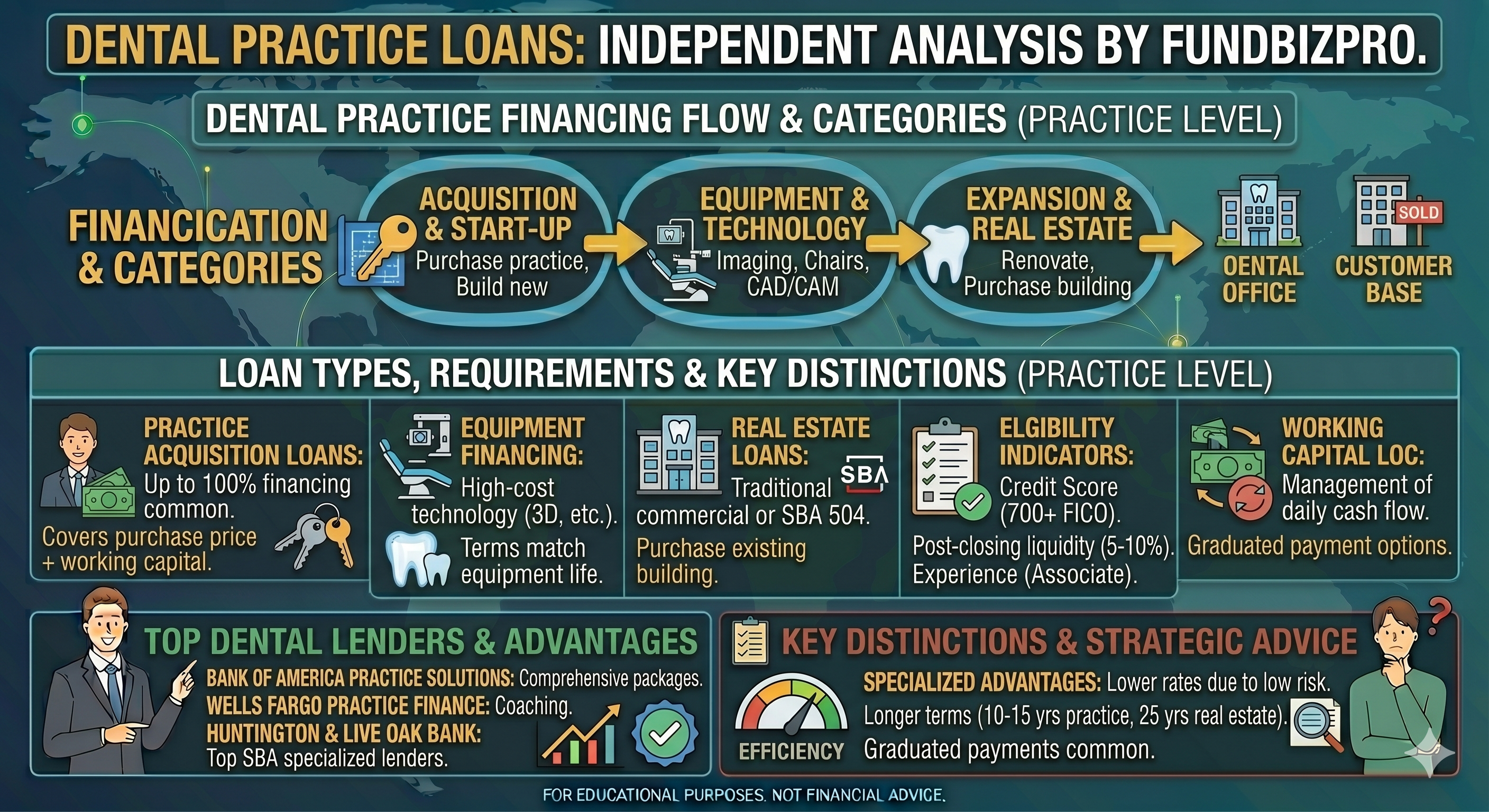
Why Dental Practice Financing Is a Different Market
Dental practices are among the most financeable small businesses in the country. Revenue is predictable (insurance reimbursement + patient billing), cash flow is documentable, and practices retain value well even in economic downturns -- people continue to need dental care regardless of economic conditions.
As a result, a distinct segment of the lending market serves dentists specifically. Specialty healthcare lenders have dental underwriting teams, relationship managers with dental industry backgrounds, and loan programs tailored to practice acquisition, startup, and equipment financing that general SBA lenders do not match.
The three main categories of dental practice loans:
SBA 7(a): The most flexible structure for acquisitions and startups. Up to $5M. Used by most buyers for practice acquisitions in the $400,000-$3M range.
Specialty healthcare lenders (Provide, BofA Practice Solutions, TD Bank Healthcare): Dental-specific underwriting, often with dental-familiar account managers. Some offer rates and terms competitive with SBA. Best for borrowers who want industry expertise in the lending relationship.
SBA 504: Best structure for major equipment purchases (CBCT imaging systems, CAD/CAM milling units, dental chairs and delivery systems). Fixed rate on 40% of project through a CDC. Lowest available rate for equipment over $150K with long useful life.
SBA 7(a) for Dental Practice Acquisition
SBA 7(a) is the dominant financing structure for dental practice acquisitions. Most practices sell for 60-80% of annual gross revenue -- a well-run general practice generating $900,000 in annual collections typically sells for $540,000-$720,000. SBA 7(a) can fund the full acquisition plus working capital.
Key terms: - Maximum: $5M - Rate: Variable, WSJ Prime + 2.75% (loans over $350K). As of May 2026, effective rates approximately 10-13%. - Term: Up to 10 years for acquisitions without real estate; up to 25 years if real estate is included. - Down payment: 10% minimum on business acquisitions. - Personal guarantee: Required for all owners with 20%+ stake.
What SBA lenders look for in dental: - 2+ years of practice tax returns (for acquisition) or dentist's personal tax returns (for startup) - Practice collections history (past 2-3 years) - Patient panel size and insurance mix (fee-for-service vs. insurance-heavy) - Equipment list and condition - Lease terms (duration, renewal options, assignment rights) - Personal credit 680+ and DSCR 1.25x or higher
SBA lenders active in dental: Bank of America Practice Solutions (top SBA healthcare lender), Live Oak Bank (strong dental vertical), TD Bank Healthcare, First Western Financial, Provide (now part of Fifth Third Bank). Search lendermatch.sba.gov for SBA Preferred Lenders in your state.
Specialty Dental Lenders: Provide, BofA Practice Solutions, TD Bank
Specialty healthcare lenders offer advantages that general SBA lenders do not: dental-specific underwriting criteria, relationship managers who understand practice valuation, and loan structures designed around how dental practices actually operate.
Provide (Fifth Third Bank): The largest dedicated dental and medical practice lender in the US. Offers practice acquisition loans, startup loans, and equipment financing. Known for accommodating dentists with student loan debt -- Provide's underwriters adjust DSCR calculations to account for student loan income-driven repayment plans. National reach. Dental-only focus means faster processing for standard deals.
Bank of America Practice Solutions: One of the top 5 SBA lenders in the country, with a dedicated healthcare practice division. Offers SBA 7(a) and conventional practice loans. Strong for borrowers who are existing BofA business customers. Practice Solutions has dental-trained underwriters and a track record in multi-location practice acquisition.
TD Bank Healthcare: Active in dental practice lending across the Northeast and Mid-Atlantic. Relationship-oriented; TD bankers often participate in local dental society events. Offers conventional and SBA-backed practice loans.
Lendeavor / US Bank Healthcare: US Bank's healthcare lending division covers dental acquisitions and startups nationally.
Comparison of key differentiators:
| Lender | Best for | Student loan treatment | Geographic focus |
|---|---|---|---|
| Provide (Fifth Third) | Startup or acquisition with student debt | Favorable | National |
| BofA Practice Solutions | Acquisition, existing BofA customers | Standard | National |
| TD Bank Healthcare | Northeast / Mid-Atlantic relationships | Standard | Northeast, Southeast |
| Live Oak Bank | SBA 7(a) acquisition loans | Standard | National |
Terms as of May 2026. Verify current rates and eligibility directly with each lender.
SBA 504 for Dental Equipment
Major dental equipment -- CBCT imaging systems ($80,000-$200,000+), CAD/CAM milling units ($60,000-$130,000), digital X-ray systems, and full operatory buildouts -- qualifies for SBA 504 financing, which offers the lowest fixed rate available for long-useful-life equipment.
How SBA 504 works for dental equipment: - Bank funds 50% of project cost at conventional rate - Certified Development Company (CDC) funds 40% at SBA-fixed rate (typically 5.5-7.5%) - You contribute 10% (15% if the business is under 2 years old) - SBA portion: fixed rate, 10 or 20-year term - Maximum SBA portion: $5M
When 504 makes sense vs. equipment financing: - 504 is worth the complexity for single equipment items over $150K with 10+ year useful life (CBCT, CAD/CAM, full chair packages) - For smaller or shorter-lived equipment (standard X-ray, handpieces, sterilization units), conventional equipment financing or an SBA 7(a) line is simpler - 504 requires a CDC as a second lender -- find one at nadco.us
Estimated savings on a $300K CBCT system: At current rates, SBA 504 structure saves approximately $20,000-$40,000 in total interest vs. conventional equipment financing over a 10-year term.
Dental Practice Startup Loans
Starting a practice from scratch (de novo) is harder to finance than acquiring an existing one, but it is not impossible -- and specialty lenders have built programs specifically for dental startups.
Why startups are harder: No revenue history, no patient panel to document, no collections data for underwriting. Lenders are betting on the dentist's income-generating ability rather than an existing asset.
What startup lenders look for: - Strong personal credit (700+ preferred; some lenders work with 680+) - 2+ years of associate dentist or dental school faculty experience - Location analysis demonstrating patient demand (dentist-to-population ratio, competitor saturation, demographics) - Detailed business plan with revenue projections tied to realistic patient acquisition assumptions - Student loan status and income-driven repayment documentation
Provide is the most startup-friendly major dental lender -- the firm was built on dental startup financing and has processed thousands of de novo loans. They offer up to $500,000 for startups without requiring an existing revenue history.
SBA 7(a) can also fund startups up to $5M, but the underwriting is stricter. Most SBA lenders require 2 years in business; dental startups are an exception category where personal credentials substitute for operating history.
How to Prepare a Dental Practice Loan Application
Whether acquiring or starting, lenders will request:
For acquisitions: - 3 years of practice tax returns (seller's) - 3 years of practice P&L statements - Recent accounts receivable aging report - Patient count and insurance mix breakdown - Lease or real estate documents - Equipment list with age and condition - Letter of intent (LOI) from buyer and seller - Your personal tax returns (2 years) - Personal financial statement
For startups: - Dental license and credentials - Detailed business plan with financial projections (36 months) - Location lease letter of intent - Equipment quote from dental supply company (Patterson, Schein, Benco) - Personal tax returns (2 years) - Student loan documentation and repayment plan
The student debt issue: Many dentists carry $200,000-$400,000 in student loans. General SBA lenders count the full monthly payment in DSCR calculations, often disqualifying dentists. Specialty lenders (Provide, TD Bank Healthcare) use income-driven repayment (IDR) plan amounts instead of standard 10-year repayment amounts -- this can meaningfully improve your qualifying DSCR. Ask your lender explicitly how they treat student loans before submitting.
This article is for informational purposes only and does not constitute financial, legal, or investment advice. Consult a licensed professional before making financing or business decisions.
Read Next
Financing
SBA 7(a) Loan Explained: Requirements, Rates, and the Real Timeline
The small business administration 7(a) loan goes up to $5 million. Here's what rates look like, who qualifies, and how to cut the 60–90 day timeline.
Financing
How to Get a Loan to Buy a Business
SBA 7(a), seller notes, ROBS, and conventional loans explained with real numbers. Learn what lenders require to fund a business acquisition in 2026.
Guide
Equipment Financing: What It Costs, How It Works, and When to Use It
Equipment financing lets businesses borrow against the equipment itself as collateral. Learn how it works, what rates to expect, and when it beats an SBA loan.
Guide
Laundromat Business Loans: How to Finance a Laundromat Business
Laundromat Business Loans: startup costs $200K–$500K, loan range $100K–$1.5M. Learn which loan types work, what lenders look for, and the industry risks that affect approval.
This article is for informational purposes only and does not constitute financial, legal, or investment advice - consult a licensed professional before making acquisition or financing decisions.
Get the Free SBA Loan Checklist
Free guide — delivered to your inbox.
Frequently Asked Questions
What is the best SBA lender for dental practice loans?
Can I get an SBA loan to buy a dental practice?
How do lenders handle student loan debt for dentists?
What credit score do I need for a dental practice loan?
Can I finance dental equipment with an SBA loan?
How much can I borrow to buy a dental practice?
Before you sign a lease, know what the data says about your address.
Score a franchise location free →Score a Location
By FundBizPro Research · Published 2026-05-02 · United States
Written by
FundBizPro Research Team
Independent research from primary sources
The FundBizPro Research Team writes from primary sources - government program documentation, SBA SOP language, lender-published rate sheets, and FDD filings - rather than aggregating other websites. Content is educational only and is not a substitute for advice from a licensed professional.
About our editorial standards →