Food Franchise Under $50k: The Honest Answer
Updated
TL;DR — Key Facts
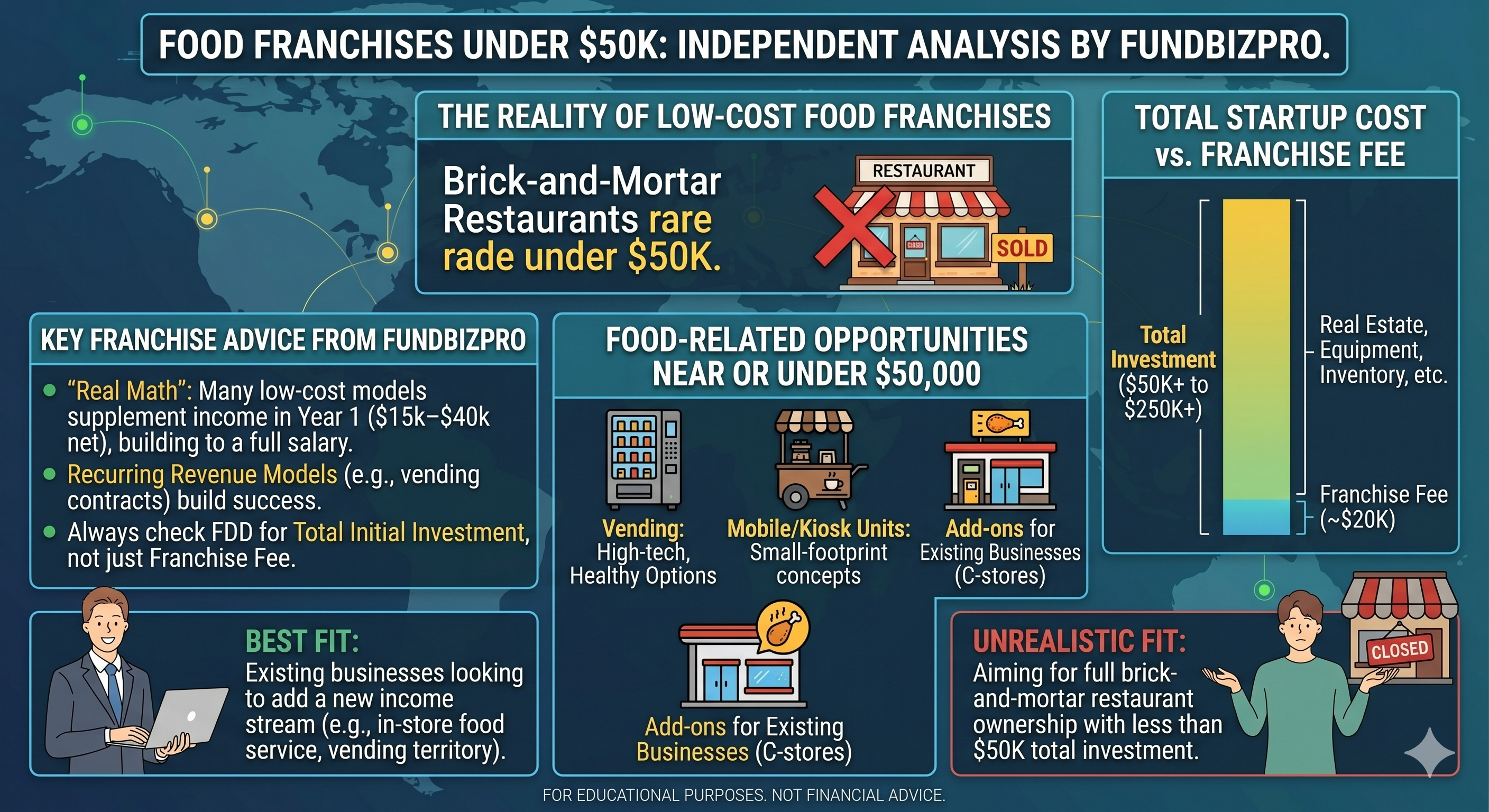
- →No branded QSR or food franchise has a total investment under $50,000 as of 2026.
- →Subway's minimum total investment is $229,050 per the 2024 FDD Item 7.
- →The cheapest branded mobile food concept (Kona Ice) requires $95,000-$145,000 total.
- →Food-adjacent vending operators start around $28,000 but are not FTC-compliant franchises.
- →Home service franchises (cleaning, lawn care) offer stronger ROI under $50,000 than any food concept at this budget.
The $50,000 Food Franchise Question
The search is common. The answer is not what most buyers expect.
No traditional food franchise -- QSR, fast casual, or food kiosk brand with a complete FTC-compliant FDD -- has a verifiable total investment under $50,000 as of 2026. That is not a technicality. It is the result of commercial kitchen infrastructure costs, health department licensing requirements, grease trap installation, and perishable inventory that make food service one of the most capital-intensive entry categories in all of franchising.
This guide explains why the gap exists, shows real FDD Item 7 numbers for the most commonly researched food brands, and gives buyers with a $50,000 budget an accurate picture of what their options actually are -- in food and outside of it.
Why Food Franchises Cost More Than Buyers Expect
Food service franchises carry build-out costs that non-food concepts simply do not. A commercial kitchen requires specialized plumbing for grease traps, high-capacity HVAC and exhaust systems, NSF-certified equipment, and fire suppression systems. These are not optional upgrades -- they are code requirements in virtually every US jurisdiction. Health department inspections occur before opening and require ongoing compliance after.
The franchisor's Item 7 (Estimated Initial Investment) captures these costs in total investment ranges. But the low end of the Item 7 range is typically a best-case scenario: a pre-equipped space with favorable lease terms and a cooperative landlord. Real buyers frequently land in the middle-to-upper portion of the Item 7 range once permit timelines, equipment lead times, and landlord negotiation delays are factored in.
Staffing is the other cost multiplier that buyers underestimate. A food franchise requires a trained team from day one. A single owner-operator can run a commercial cleaning route or a lawn care service territory. No owner-operator can run a Subway location alone during service hours. Labor is both a fixed cost and a management burden that starts before the doors open.
At the April 2026 Montreal Franchise Expo, a commercial lender described food service as the hardest franchise category to finance. Not just the most expensive to build -- the hardest to get bank approval. Lenders apply significantly more scrutiny to food service underwriting than to non-food franchise acquisitions.
What Food Franchise Investment Actually Looks Like
The table below draws from publicly available FDD Item 7 disclosures for the most commonly searched food franchise brands. Ranges reflect total initial investment as disclosed in each brand's most recently available FDD.
| Brand | Total Investment (FDD Item 7) | Franchise Fee | Format |
|---|---|---|---|
| Subway | $229,050-$521,437 (2024 FDD) | $15,000 | Inline storefront |
| Kona Ice | $95,000-$145,000 | $15,000 | Mobile food truck |
| Auntie Anne's kiosk | $133,295-$412,650 | $30,000 | Mall kiosk |
| Wetzel's Pretzels kiosk | approx. $182,000-$387,000 | $35,000 | Mall kiosk |
| Tim Hortons (CAD) | $480,000-$1.9M CAD | $50,000 CAD | Standard or drive-through |
Figures are in USD unless otherwise noted. Tim Hortons figures are in Canadian dollars and reflect Canadian FDD disclosures. Wetzel's Pretzels figures are approximate based on publicly available disclosure summaries -- verify current figures directly with the franchisor. All ranges are as of 2024-2025 FDD filings; verify current investment figures at each brand's discovery portal.
The lowest single entry in the table -- Kona Ice at $95,000 -- nearly doubles the $50,000 target budget. And Kona Ice is a branded mobile food truck, not a traditional storefront franchise. Even at the absolute floor of the food franchise market, the investment exceeds $50,000 by a significant margin.
What the Franchisor Sales Team Will Not Volunteer
Health department licensing is a hard prerequisite, not a formality. Before a food franchise can open, it must pass local health department inspections covering kitchen layout, equipment placement, water temperature, food storage, and pest control compliance. In many jurisdictions, plan review adds 60-90 days to the opening timeline and requires stamped architectural drawings -- a line item that often appears late in the buyer's due diligence process.
The low end of Item 7 is optimistic. Franchisors construct their Item 7 ranges using data from recent openings, but the low end reflects favorable conditions: a pre-existing commercial kitchen, landlord improvement allowances, and no permitting delays. Most buyers in standard markets land closer to the middle of the range.
Food franchises carry the highest combined royalty loads in franchising. QSR and fast-casual concepts typically charge 10-14% of gross sales in combined royalties and advertising fund fees. On $600,000 in annual revenue, that is $60,000-$84,000 per year in fees before rent, labor, or food costs.
Food franchises are harder to finance than non-food concepts. Lenders at the 2026 Montreal Franchise Expo confirmed this directly. SBA underwriting for food service requires more collateral, higher cash injection, and more documentation than for a commercial cleaning or service territory franchise. Buyers who are already at the edge of their available capital face a harder approval path.
What One Buyer Discovered When Researching Food Franchises
A buyer in suburban Minneapolis spent three months researching food franchises in late 2024, focused specifically on concepts with low entry costs. She had $45,000 in liquid capital. After reviewing the Subway FDD (Item 7 minimum: $229,050) and two regional food concepts in the $140,000-$180,000 total investment range, she concluded that no food franchise was accessible at her budget.
She pivoted to a Coverall commercial cleaning territory at $18,500 total investment, funded entirely from savings. Within four months, she had two commercial cleaning accounts generating $2,600 per month in gross revenue. The business operates from her vehicle with no commercial lease.
This is a representative scenario based on typical entry-level commercial cleaning acquisitions for buyers who research food franchises first. The pivot is common. It requires adjusting expectations about what business ownership looks like -- it does not require additional capital.
What Your $50,000 Budget Actually Buys
Understanding the budget tiers in franchising helps buyers move from food-specific expectations to a realistic view of what each investment level unlocks.
Under $50,000: No food franchise exists in this range. Home service and commercial cleaning franchises dominate. Jan-Pro, Jani-King, Stratus, Coverall, and Lawn Doctor all have entry packages at or near this threshold. These are established businesses with recurring revenue and FDD Item 19 earnings disclosures. FundBizPro's guide to franchises under $50,000 covers the full category.
$50,000 to $150,000: Still no traditional QSR. Kona Ice ($95,000-$145,000) is the primary food-adjacent option at this level. B2B service and staffing franchise concepts enter here as well. FundBizPro's B2B franchises under $150,000 guide covers the non-food options in this range.
$150,000 to $350,000: The first traditional food franchise formats become accessible. Auntie Anne's kiosk ($133,295 at the FDD low end), some Subway configurations, and regional QSR brands. SBA 7(a) financing is the standard funding structure at this level and typically requires 10-20% cash injection from the buyer.
$350,000 and above: Standard QSR storefronts -- Subway, Dunkin', Wingstop, most major national brands. These require SBA 7(a) or SBA 504 financing, often combined with seller notes or investor capital. Most buyers entering this tier have prior franchise experience or industry background.
Buyers with $50,000 who want to be in the food industry without a traditional franchise have two realistic options: food-adjacent vending (Naturals2Go and similar operators start around $28,000, though these are not FTC-compliant franchise systems), or saving toward the $95,000-$150,000 threshold where mobile food franchises become available.
Who Searches for Food Franchises Under $50,000
Three buyer profiles most commonly generate this search.
First-time buyers who associate food with accessibility. They grew up with fast food and assume the entry cost reflects the familiarity of the product. The FDD numbers close that assumption quickly. This group benefits most from reading Item 7 directly before any further research.
Immigrants with food service experience who want to formalize their skills in a franchise structure. This is a legitimate aspiration -- but the capital requirement is a real barrier, and the FDD review process in both the US and Canada is required regardless of industry background. Buyers in this group who do not meet the investment threshold often explore SBA microloans or CDFI financing while saving toward a larger capital base.
Buyers who are still in the early research phase and have not yet reviewed an FDD. These buyers are the most likely to pivot once they understand the actual Item 7 numbers. A conversation with an SBA-preferred lender is typically the fastest path to understanding what their capital supports -- lenders can tell buyers in 15 minutes whether their budget is viable for a specific franchise category.
How We Researched This
This guide references publicly available Franchise Disclosure Documents for Subway (2024 FDD, Item 7), Kona Ice, Auntie Anne's, and Wetzel's Pretzels. Tim Hortons data reflects Canadian FDD disclosures in Canadian dollars. Vending route figures (Naturals2Go) are drawn from publicly available operator literature and are not FDD-backed disclosures. All USD figures are in US dollars unless otherwise noted. Financing notes reference SBA program guidelines at sba.gov. Verify current investment ranges and FDD figures directly with each franchisor before making investment decisions.
Read Next
Guide
Franchises Under $50,000 Total Investment: 12 Legitimate Options
Under-$50K franchises are home-based service businesses - no storefront. Real FDD costs, earnings data, and 12 legitimate options for 2026.
Guide
Best B2B Franchises Under $150,000 Total Investment
Six B2B franchises under $150,000 total investment - commercial cleaning, business brokerage, and service territories with recurring revenue and real FDD costs.
Guide
Jollibee Franchise Cost: What It Actually Takes to Open One
Jollibee franchise cost: $1.3M–$3.8M total per FDD Item 7. Franchise fee $50K, 5% royalty, SBA 7(a) financing, and who Jollibee is accepting in 2026.
Guide
Franchise Disclosure Document Red Flags Every Buyer Must Know
7 franchise disclosure document red flags - from missing Item 19 to renewal clauses that reset your deal. Real numbers, FDD items named. Read before you sign.
Your Next Step
This article is for informational purposes only and does not constitute financial, legal, or investment advice - consult a licensed professional before making acquisition or financing decisions.
Score your trade area before committing to a food franchise location.
Free guide — delivered to your inbox.
Frequently Asked Questions
Are there any food franchises under $50,000?
Why do food franchises cost so much to start?
What is the cheapest food franchise to buy?
Can I get an SBA loan for a food franchise?
What franchises can I buy for $50,000?
Is a food truck franchise possible under $50,000?
Enter your capital and credit profile. See which franchise price bands you actually qualify for.
See what total investment you can afford →Score a Location
By FundBizPro Editorial · Published 2026-05-01 · United States
Written by
FundBizPro Editorial Team
Independent research from FDD filings and primary sources
The FundBizPro Editorial Team covers North American franchise costs, FDD analysis, site selection, and acquisition financing. Articles draw on current FDD filings and primary industry sources and are reviewed before publication. Content is educational only and is not a substitute for advice from a licensed professional.
About our editorial standards →