Small Business Administration 504 Loan Program: When It Makes More Sense Than 7(a)
Updated
TL;DR — Key Facts
- →SBA 504 covers commercial real estate and long-life equipment — not working capital, goodwill, or pure business acquisitions without real property.
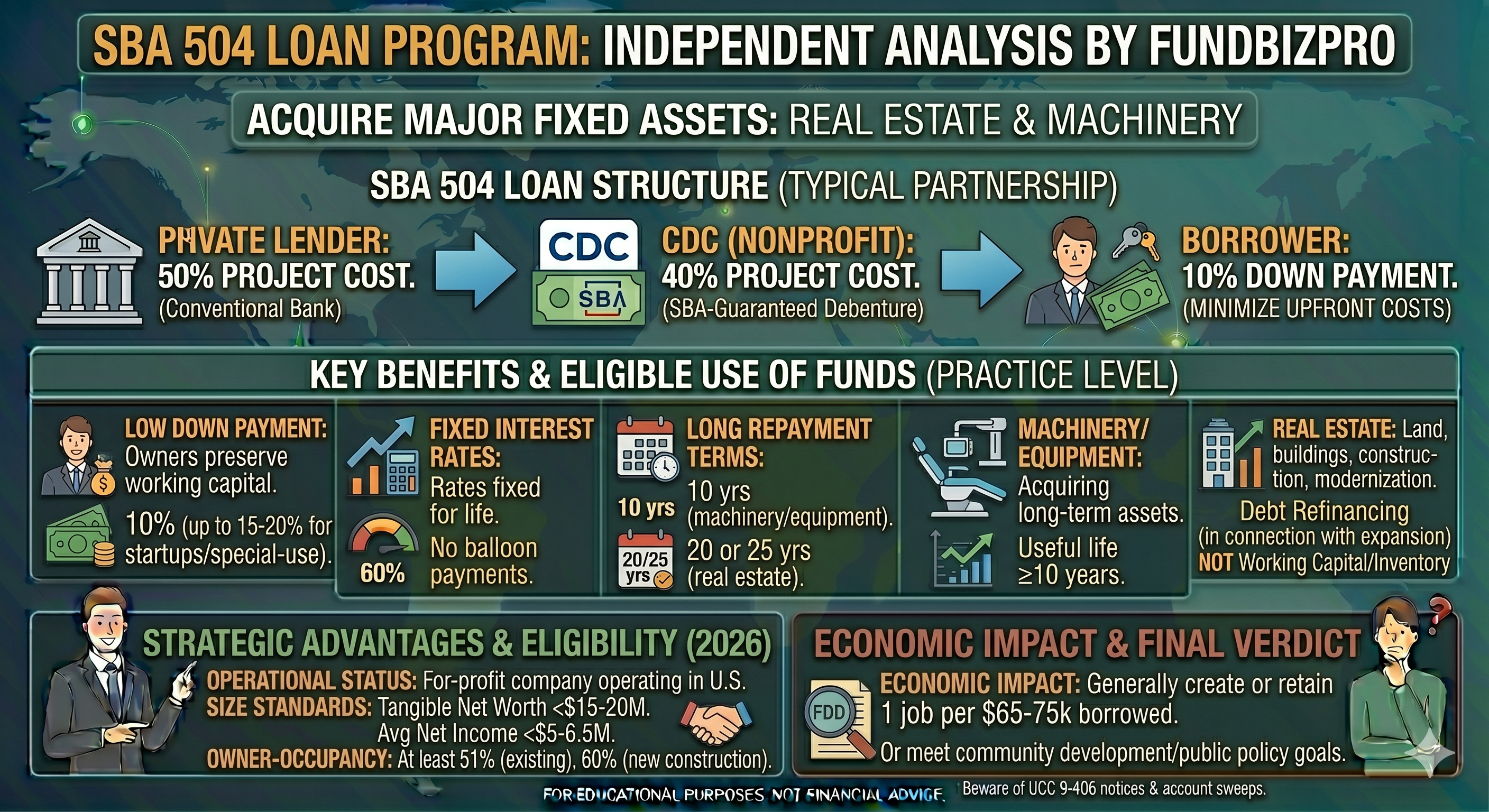
- →Three-layer deal: bank first-position at 50%, CDC/SBA debenture at 40% with a fixed rate, and your 10% equity injection — the same floor the SBA 7(a) program requires.
- →CDC tranche fixed rates in Q2 2026: approximately 6.5%–7.2% on 10-year terms and 6.8%–7.5% on 20-year terms, locked at debenture sale for the full term.
- →SBA 7(a) goes up to $5 million and covers the full acquisition — goodwill, inventory, and working capital — making it the right first call for most deals.
- →Lenders require a minimum 1.25x DSCR across both 504 tranches combined. Below that threshold, the application doesn't advance.
What the SBA 504 program is and who it's built for
The SBA 504 program does one thing: long-term, fixed-rate financing for major fixed assets. Commercial real estate. Heavy equipment with a useful life of at least ten years. That's the scope.
If you're buying a business without real property — a leased QSR location, a service franchise, an online operation — 504 is not available. That's the SBA 7(a)'s territory. The 7(a) program covers the full acquisition: business premium, goodwill, inventory, working capital, and real estate up to $5 million. For most small business deals, 7(a) is the right starting point.
What most advisors don't clearly state: 504 operates through Certified Development Companies — approximately 260 SBA-licensed nonprofits with territorial rights across the US. You apply through a bank and a CDC simultaneously, not through the SBA directly. That two-lender coordination adds complexity and roughly two to four weeks compared to a straight 7(a) application. The fixed-rate CDC tranche is the trade-off. Whether it's worth it depends on how much real estate is in your deal.
In 2026, 504 is most relevant for franchise buyers building or purchasing owned locations, operators whose acquisitions include the building, and buyers who want rate certainty on a significant portion of long-term commercial real estate financing.
How SBA 504 loans are structured
The 504 program uses a three-layer structure that most first-time buyers find counterintuitive. Understanding each layer is essential before you approach either the bank or the CDC.
Layer one is a conventional first-position bank loan covering 50% of total project cost. Standard commercial lending — the bank uses its own money, takes a first lien position, and negotiates the rate directly with you. In 2026, participating banks price their first-position tranches at 8%–11%, variable or fixed depending on lender and borrower profile. No SBA rate caps apply here. Shop multiple banks.
Layer two is the CDC/SBA debenture covering 40% of project cost. This is the program's core advantage. The debenture carries a fixed rate tied to the prevailing Treasury rate at the time of sale — and that rate doesn't change for the full 10, 20, or 25-year term. As of Q2 2026, CDC debenture effective rates run approximately 6.5%–7.2% on 10-year terms and 6.8%–7.5% on 20-year terms, with the SBA and CDC servicing fees already folded into the structure.
Layer three is your equity injection — 10% of total project cost as the standard floor. New businesses under two years old require 15%. Special-use properties (car washes, gas stations, hotels) also require 15%. New businesses in special-use properties require 20%.
A worked example: buying a commercial building for $1.5 million to house a franchise location. The bank lends $750,000 at 9.5%. The CDC lends $600,000 at 7.0% fixed for 20 years. You put in $150,000 — a 10% equity injection. The blended rate across both tranches runs below what a straight SBA 7(a) loan at 11%–13.25% on the full amount would cost, and the 40% fixed portion doesn't move with prime rate changes.
One detail most guides skip: the equity injection must come from verified personal funds. Borrowed funds don't qualify. ROBS (Rollover for Business Startups) — which converts a qualifying retirement account of at least $50,000 into business equity without triggering a taxable distribution — counts as an acceptable source.
2026 rates on SBA 504 loans
The CDC tranche rate is fixed at debenture sale and does not adjust for the life of the loan.
| Debenture term | Approximate effective rate (Q2 2026) |
|---|---|
| 10-year | 6.5%–7.2% |
| 20-year | 6.8%–7.5% |
| 25-year (owner-occupied real estate only) | 7.0%–7.8% |
These are all-in rates. The SBA servicing fee (approximately 0.641%) and CDC servicing fee (approximately 1.5%) are already folded into the debenture structure — no separate fees on top.
A detail most comparison guides miss: the CDC debenture rate is set when the debenture is sold to investors — typically 30–60 days after your loan closes, not at application. You get an estimate upfront, but the final rate locks post-close. In a rising-rate environment, this creates a narrow window of uncertainty. Ask your CDC how current debenture rates are trending as you approach closing.
The bank tranche is a different calculation. That 50% conventional loan is priced by the bank, unregulated by the SBA. On a $1.5M total project, a half-point difference in the bank tranche adds roughly $20,000–$30,000 over the term. Don't take the first bank quote.
For context: SBA 7(a) loans above $350,000 price at prime plus up to 2.75% — approximately 11.25% variable in Q2 2026. A blended 504 structure at 9.5% bank tranche and 7.0% fixed 20-year CDC tranche produces a materially lower effective rate on a large deal. For any project above $1M that includes owner-occupied real estate, run the full numbers both ways before defaulting to 7(a).
SBA 504 eligibility requirements
SBA 504 eligibility has two layers: what the SBA program requires and what the individual bank and CDC add on top. Meeting program minimums doesn't guarantee approval.
The SBA-level requirements include: the business must be for-profit and operate in the US; tangible net worth under $20 million and average net income after taxes under $6.5 million for the prior two years; and the project must meet at least one SBA public policy goal, with job creation being the most common — typically one job created or retained per $90,000 of CDC loan.
Eligible use of proceeds is the critical restriction. The 504 program covers owner-occupied commercial real estate, long-term equipment with a useful life of ten or more years, and eligible soft costs tied to those assets — architect fees, environmental assessments, title costs. Working capital, inventory, goodwill, and debt refinancing are not eligible.
Most participating banks and CDCs require a personal credit score of 680 or higher. Cash flow matters too: lenders require a minimum 1.25x DSCR across the combined debt service of both tranches. A business that generates $1.24 for every $1.00 of annual loan payments falls below the threshold and won't proceed regardless of other qualifications.
The practical eligibility question: is real property a genuine and significant part of your deal? If yes, 504 deserves comparison. If real estate is incidental or the deal is primarily a business acquisition with working capital needs, 7(a) is the right starting point.
SBA 504 vs SBA 7(a): the decision framework
Most buyers approach lenders asking about 7(a) because it's better known and more versatile. That's reasonable — SBA 7(a) loans go up to $5 million, cover business acquisitions without real property, and handle working capital alongside acquisition financing. For most deals, 7(a) is the right default.
504 wins in specific conditions.
Use 504 when the deal includes purchasing commercial real estate valued above $500,000. Use it when you want a fixed rate on 40% of your financing for 10–25 years. Use it when real estate represents 50% or more of total project cost. Use it when you're building out or substantially renovating a commercial space you'll own.
Use 7(a) when buying a business without real property — leased space, a service business, or an online operation. Use it when you need working capital mixed into the same financing structure. Use it when total project cost falls below $500,000, where 504's coordination complexity isn't justified. Use it when speed matters — a well-organized 7(a) application with an SBA Preferred Lender can close faster than a two-lender 504 coordination.
The determining question: does this deal involve buying or building a commercial property you will occupy? If yes, get a 504 quote alongside your 7(a) comparison. If no, start with 7(a).
One common hybrid: buyers use 504 for the real estate component and a separate 7(a) loan for business premium, goodwill, and working capital above what 504 covers. This is legal and done regularly. Ask your lender whether your deal structure supports a parallel 504/7(a) approach.
How to apply for an SBA 504 loan
The 504 application runs in parallel across two separate lenders — the bank and the CDC. That coordination is the main source of timeline complexity compared to a straight 7(a) application.
Start with the bank. Most banks that actively do 504 deals have established CDC relationships and can introduce you to their partner. The bank's initial conversation covers project cost, asset breakdown, your credit profile, and your equity injection amount. Understand the bank's appetite before committing time to a full application.
Both lenders conduct independent underwriting. The bank reviews your standard commercial real estate package: personal tax returns, business financials, property appraisal, and a Phase I environmental site assessment. Every commercial real estate purchase requires a Phase I — budget $1,500–$3,000 and two to three weeks for it. If Phase I identifies concerns, a Phase II ($5,000–$20,000+) follows. Order the environmental assessment as soon as you have a signed purchase agreement, not after starting the loan application. Weeks lost here can cost you a deal.
The CDC submits its tranche to the SBA for approval, adding two to four weeks beyond what a PLP 7(a) lender would face through in-house approval. Total time from complete application to closing: 60–90 days on a clean deal. Build this into your purchase timeline.
Common use cases for franchise buyers
For franchise buyers, the 504 program applies in three situations.
Building out a new owned location is the clearest case. Franchise systems that allow or require buyers to own the commercial space rather than lease — certain QSR brands, automotive service concepts, and convenience store operators — involve real estate purchases and construction that fit 504 precisely. The building purchase or construction qualifies. Long-life equipment with a ten-year-plus useful life can be folded into the project.
Buying an existing franchise that includes the real estate is the second scenario. Some franchise resales involve a seller who owns both the business and the building. When real estate represents a meaningful portion of total purchase price, structure 504 for the real estate tranche and a separate SBA 7(a) loan for business premium, goodwill, and working capital.
Converting from a lease to ownership is the third scenario. If you're operating a franchise in leased space and the landlord offers to sell, 504 is available for that real estate acquisition. Owner-occupied commercial real estate is the program's primary use case and receives the most CDC support.
Ask your franchisor's development or real estate team whether they have relationships with 504-experienced lenders. Established franchise systems often work with banks whose underwriters know the brand's FDD and unit economics — which shortens bank underwriting considerably. ROBS (Rollover for Business Startups) can serve as the 10% equity injection if you have a qualifying retirement account of at least $50,000, letting you use retirement savings without triggering a taxable distribution.
Read Next
Financing
SBA 7(a) Loan Explained: Requirements, Rates, and the Real Timeline
The small business administration 7(a) loan goes up to $5 million. Here's what rates look like, who qualifies, and how to cut the 60–90 day timeline.
Financing
How to Get a Small Business Loan: The Honest Guide
How to get a small business loan - what banks check, why applications fail, and which loan type fits your deal. Real numbers, real lender criteria.
Lender Review
Funding Circle Review: The Best Rate Among Alternative Lenders
Independent Funding Circle review - rates (11%–45% APR), strict requirements, US and Canada availability, and who qualifies for the lowest alternative lending rates.
Financing
SBA Microloans for Startups: The $50k Option
SBA Microloans up to $50,000 through nonprofit lenders, not banks - lower credit thresholds, available in all 50 states including Missouri, Texas, and California. No storefront required. Updated 2026.
This article is for informational purposes only and does not constitute financial, legal, or investment advice - consult a licensed professional before making acquisition or financing decisions.
Planning a franchise buildout? Score the location before you finance it.
Free guide — delivered to your inbox.
No spam. Unsubscribe any time. Our privacy policy explains how we store and use your email.
Frequently Asked Questions
What is the maximum SBA 504 loan amount?
Can I use an SBA 504 loan to buy a business?
What is the down payment for an SBA 504 loan?
How long does an SBA 504 loan take to close?
Is the SBA 504 rate fixed or variable?
What is a CDC and do I need to find one myself?
Answer 10 questions. See which lenders match your profile and what loan types fit.
Check your loan readiness →Score a Location
By FundBizPro Research · Published 2026-04-18 · Updated 2026-05-12 · United States
Written by
FundBizPro Research Team
Independent research from primary sources
The FundBizPro Research Team writes from primary sources - government program documentation, SBA SOP language, lender-published rate sheets, and FDD filings - rather than aggregating other websites. Content is educational only and is not a substitute for advice from a licensed professional.
About our editorial standards →