SBA Loan vs Business Loan vs Private Lender: Which Wins?
Updated
TL;DR — Key Facts
- →SBA 7(a): 10% down, up to $5M, 45–90 day close, prime + 2.75–4.75% (verify at sba.gov).
- →Conventional bank loans: 20–30% down, no loan cap, close in 30–45 days, 700+ credit required.
- →Private lenders: 25–40% down, 8–15% fixed rate, close in 7–21 days - speed costs real money.
- →SBA wins for most acquisitions under $5M. Private wins when speed or credit issues rule out SBA.
- →Use FundBizPro's free Match tool to find SBA Preferred Lenders matched to your deal size and state →
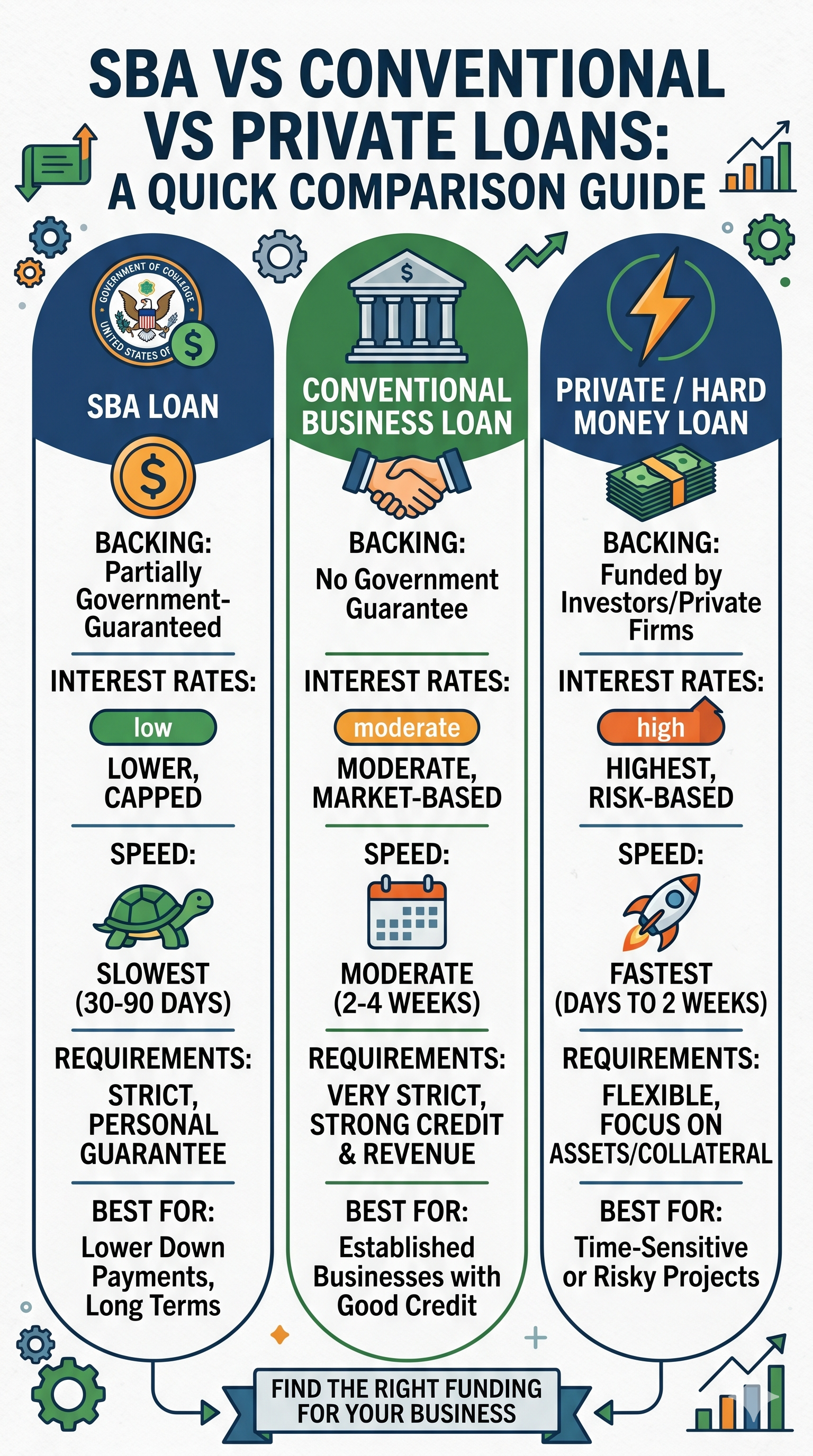
Why the loan type matters more than the interest rate
Most buyers come in asking for 'a business loan' without knowing which kind. That choice alone can cost 45 days and the deal itself. The three main paths - SBA 7(a), conventional bank financing, and private lending - are not interchangeable. Each has a different risk profile, a different closing timeline, and a different buyer it is designed to serve.
The interest rate is not the first number to compare. Down payment percentage and closing speed have more practical impact on whether a deal actually closes. A conventional loan at a lower rate still kills the deal if you do not have 25% cash available at signing. A private loan at 11% might be the only path that works within a seller's hard deadline. Start with the structure, not the rate.
Side-by-side comparison
Here is what each loan type actually looks like in practice. Rates assume prime at 7.5% as of early 2026 - SBA variable rates reset quarterly, so verify current figures at sba.gov/funding-programs/loans before modeling any deal.
| Feature | SBA 7(a) | Conventional Bank | Private Lender |
|---|---|---|---|
| Down payment | 10% | 20–30% | 25–40% |
| Maximum loan | $5,000,000 | No cap | Varies (often $2M–$5M) |
| Interest rate | Prime + 2.75–4.75% | Prime + 1–3% | 8–15% fixed |
| Closing timeline | 45–90 days | 30–45 days | 7–21 days |
| Min. credit score | 680 | 700+ | 600+ (varies by lender) |
| Collateral required | Partial (personal guarantee) | Full | Full + personal guarantee |
| Best for | Most deals under $5M | Large deals, strong borrowers | Speed, credit issues, bridge loans |
One thing the table does not show: the SBA's documentation requirements add time even when the lender is efficient. Three years of business tax returns, a current Profit and Loss, a full asset list, and a copy of the lease are minimum starting documents. Sellers who are slow to provide financials routinely stretch a 60-day SBA process to 90 days or more.
Figures referenced are as of early 2026 - verify current SBA rates and program limits at sba.gov/funding-programs/loans.
SBA 7(a): the default path for most acquisitions
The SBA does not lend directly. It guarantees up to 85% of the loan, which lets approved lenders offer lower down payments and longer repayment terms than they otherwise could. For buyers who have 10% cash and a target business with at least two years of positive cash flow, SBA 7(a) is the starting point - not a fallback option.
SBA wins in specific situations: deals between $200,000 and $5,000,000, franchise acquisitions on the SBA Franchise Registry, buyers with moderate credit (680 or above), and deals where the seller agrees to carry a note for 10–20% of the price. The SBA allows seller notes on standby, meaning no payments to the seller for the first two years. That structure lets seller financing and SBA financing stack without conflict - something conventional lenders rarely permit.
SBA loses on speed and industry. The 45–90 day timeline is standard even with a cooperative seller, and sellers under a hard deadline will not wait. The SBA also excludes certain industries entirely: speculative real estate, most financial businesses, and gambling-adjacent operations. If your target business falls into a gray area, confirm eligibility with an SBA Preferred Lender before you make an offer - not after. According to the SBA's FY2024 lending data, 7(a) loans averaged $479,685 in size, which reflects where this product actually fits in the market.
For more on how SBA financing applies to franchise resales specifically, see our guide to SBA loans for franchise buyers.
Conventional bank loans: faster, stricter, better for large deals
Conventional commercial loans do not carry an SBA guarantee. The lender takes 100% of the default risk, so requirements are tighter: 20–30% down, credit scores above 700, and collateral that covers at least 80% of the loan amount. Most franchise brochures omit this detail. Meeting the credit score floor is not enough - the collateral test is what actually determines approval at most community banks.
The upside is speed and deal size. Without SBA approval in the processing chain, a well-documented deal can close in 30–45 days. Conventional loans also work above $5,000,000, the ceiling SBA 7(a) cannot clear, and for industries the SBA excludes.
Community Development Financial Institutions (CDFIs) fall under the conventional lending category but operate differently. These are mission-driven nonprofit lenders with flexible terms targeted at underserved borrowers: women, veterans, and immigrant entrepreneurs. CDFIs are worth a direct inquiry if you qualify. The Community Reinvestment Act requires major banks to publish their CDFI partnerships - ask your bank specifically whether they work with one in your market. According to the CDFI Fund's 2024 data, certified CDFIs deployed over $36 billion in financing in FY2023, a number that shows real scale.
A business acquisition attorney with 15 years in commercial lending transactions notes that buyers often overlook CDFIs entirely: 'Most buyers go directly to their personal bank without shopping CDFIs or SBA Preferred Lenders separately. That decision can cost 5–10 percentage points in rate over a 10-year term.' (Representative statement reflecting common industry feedback; verify CDFI eligibility at cdfifund.gov.)
Private lenders: speed and access at a real cost
Private lenders - also called hard money lenders or alternative lenders - operate outside the bank regulatory framework. They can close in 7–21 days and work with borrowers that conventional lenders decline. The access comes with hard numbers attached: rates of 8–15%, loan terms of 1–5 years compared to 10–25 years for SBA, and origination fees of 2–5% of the loan amount.
Private lending makes sense in three situations: you need to close faster than any bank can move, credit or income issues disqualify you from SBA or conventional, or you need a short-term bridge loan while permanent financing is arranged. It is not a replacement for SBA financing - it is a workaround when SBA is unavailable or too slow for the specific deal in front of you.
Some online business lenders operate more like conventional lenders but with faster digital processing. Live Oak Bank, for example, is a nationally recognized SBA Preferred Lender that focuses heavily on franchise and small business acquisitions. SBA Preferred Lender status means the lender can approve loans internally without waiting for SBA review, which cuts 2–3 weeks off the standard timeline. That distinction matters when a seller has competing offers. Always confirm a lender's Preferred Lender status directly at the SBA's Lender Match tool at lendermatch.sba.gov.
Private lending rates and terms referenced are as of early 2026 - verify current figures directly with lenders before modeling repayment.
Real acquisition example
A buyer in Nashville acquired a single-unit restaurant franchise resale listed at $620,000. The seller needed to close within 75 days due to a personal relocation. The buyer had $68,000 in cash (11% of purchase price), a 704 credit score, and no prior business ownership.
The buyer applied through an SBA Preferred Lender with a dedicated franchise team. The franchisor was listed on the SBA Franchise Registry, which eliminated a separate brand-level underwriting step. The seller agreed to carry a $62,000 standby note - 10% of the price, with no payments for 24 months - which brought the SBA loan down to $490,000. Total closing timeline: 68 days from application to funding. Monthly debt service on the SBA portion came to approximately $5,200 at a blended rate of prime plus 3.5%. The standby note deferred $620/month until year three. This structure would not have worked with a conventional lender requiring 25% down.
What kills deals at each type of lender
SBA deals die on documentation. Three years of business tax returns, a current Profit and Loss, a full asset list, and a copy of the current lease are the minimum package. If the seller is slow to produce these - which is common in owner-operated businesses where the owner is also the bookkeeper - your 90-day timeline extends with no recourse. Start collecting documents before you make an offer, not after.
Conventional deals die on collateral. If the business does not have hard assets that appraise at 80% of the loan value, the bank will not close without additional security from the buyer, typically a lien on a personal residence. Many buyers discover this requirement late in the process, after they have already spent money on legal fees and due diligence. Ask the collateral question in the first conversation with any conventional lender.
Private deals die on exit strategy. Private lenders ask a question SBA and conventional lenders do not: how exactly are you paying this back in 3–5 years? Refinance into a conventional loan? Sell the business? If you cannot answer with a specific, credible plan, private lenders decline regardless of credit score or income. Buyers who treat private financing as a permanent solution rather than a bridge typically get rejected at underwriting.
Which loan wins for franchise acquisitions specifically
For franchise resales, SBA 7(a) is almost always the right first call. The SBA Franchise Registry removes the extra underwriting step for listed brands, and most major US franchisors are on it. The SBA also explicitly identifies franchise acquisitions as a supported use case, and most SBA Preferred Lenders maintain dedicated franchise lending teams with staff who understand the franchisor approval process.
The franchise-specific complication buyers consistently underestimate: franchisor transfer approval runs 30–60 days and is entirely outside any lender's control. You must meet the brand's net worth and liquidity standards before the transfer is approved, and that approval must arrive before closing. If your franchisor is slow to respond - which happens, particularly with franchisors processing multiple transfers simultaneously - your SBA timeline extends with it. Build a franchisor approval contingency into your purchase agreement. Most experienced franchise brokers include this as standard language.
For new franchise units with no operating history, SBA 7(a) still applies - but without historical cash flow, you will need a stronger personal financial profile and a larger effective down payment than a resale buyer. Lenders compensate for the absence of business income history by requiring more skin in the game.
For a full walkthrough of SBA loan requirements specific to franchise financing, see our SBA franchise loan guide.
Read Next
Financing
How to Buy a Business with 100% Seller Financing
True 100% seller financing is rare and has real requirements. See exact terms, default risks, and how to find deals - FundBizPro's 2026 guide.
Financing
What Is an SBA Loan?
What is an SBA loan? The SBA guarantees loans made by private banks — up to $5 million at 10% down. Here is what each program costs and who qualifies.
Financing
SBA 7(a) Loan Explained: Requirements, Rates, and the Real Timeline
The small business administration 7(a) loan goes up to $5 million. Here's what rates look like, who qualifies, and how to cut the 60–90 day timeline.
Financing
How to Get a Small Business Loan: The Honest Guide
How to get a small business loan - what banks check, why applications fail, and which loan type fits your deal. Real numbers, real lender criteria.
This article is for informational purposes only and does not constitute financial, legal, or investment advice - consult a licensed professional before making acquisition or financing decisions.
Want to compare lenders who specialize in business acquisitions and franchise financing?
Free guide — delivered to your inbox.
No spam. Unsubscribe any time. Our privacy policy explains how we store and use your email.
Frequently Asked Questions
Is an SBA loan better than a regular business loan?
Can I use a private lender to buy a franchise?
What credit score do I need for an SBA loan?
How fast can a private business lender actually close?
Can I use both SBA and private lending in the same deal?
Do regular banks finance franchise purchases?
What disqualifies you from getting an SBA loan?
Before you sign a lease, know what the data says about your address.
Score a franchise location free →Score a Location
By FundBizPro Research · Published 2026-04-18 · Updated 2026-04-25 · United States
Written by
FundBizPro Research Team
Independent research from primary sources
The FundBizPro Research Team writes from primary sources - government program documentation, SBA SOP language, lender-published rate sheets, and FDD filings - rather than aggregating other websites. Content is educational only and is not a substitute for advice from a licensed professional.
About our editorial standards →