How to Buy a Business with 100% Seller Financing
Updated
TL;DR — Key Facts
- →Fewer than 5% of listings offer true 100% seller financing - most 'seller financing' deals carry only 10–30% alongside a bank loan.
- →Typical terms: 7–9% fixed interest, 5–7 year term. A $400,000 deal costs $6,223–$7,013/month.
- →Sellers require 720+ credit score, 3+ years direct industry experience, and 1.5x DSCR at the proposed payment.
- →Default gives the seller full foreclosure rights over all business assets - the same legal remedy a bank holds.
- →Use FundBizPro's free Acquisition Match tool to find seller-financing-ready deals in your industry.
What '100% seller financing' actually means
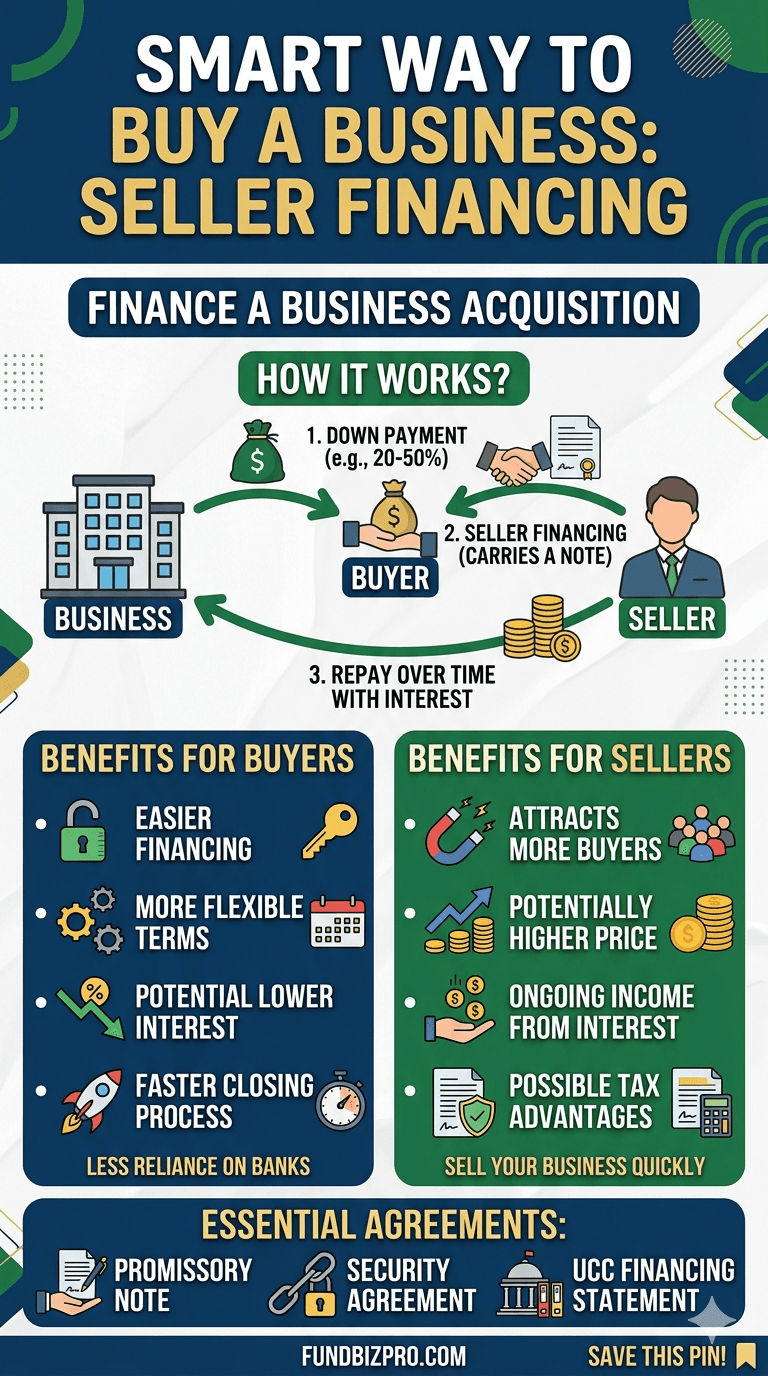
A listing marked 'seller financing available' almost never means what most buyers hope. The majority of seller-financed listings on BizBuySell and BizQuest describe a seller carrying 10–20% of the purchase price alongside a bank loan. That is a seller note, not 100% seller financing. A true 100% seller-financed transaction has no bank, no SBA loan, and no institutional debt of any kind. The seller is the only creditor.
The legal structure is simple on paper. Buyer and seller agree on a purchase price, an interest rate, a repayment term, and a security interest in the business assets. The buyer pays the seller monthly. If payments stop, the seller has the right to foreclose and reclaim the business - the same remedy a bank would hold.
The short answer on cost, timeline, and ROI:
- Total cost: purchase price plus interest; $400,000 at 8% over 6 years equals approximately $446,000 total, or $7,013/month
- Timeline to close: 2–4 weeks with a business attorney; no bank underwriting required
- Realistic ROI window: year one is typically break-even or slightly positive; meaningful cash flow builds in years 2–3 as revenue grows against a fixed payment
The full requirements in one table:
| Factor | Typical Terms |
|---|---|
| Credit score | 720+ practical minimum; 740+ gives negotiating leverage |
| Industry experience | 3+ years direct experience in the same sector |
| Cash reserve | 3–6 months operating expenses in liquid accounts |
| Debt service coverage | 1.5x DSCR at the proposed monthly payment |
The deal requires the same legal documents as any acquisition: asset purchase agreement, promissory note, security agreement, and a non-compete, all governed by state contract law. Removing the bank does not reduce the legal complexity. It removes one set of parties from the closing table and shifts the underwriting responsibility entirely to a retiring business owner who may or may not have done this before.
Why sellers agree to carry 100%
Three situations produce sellers willing to finance the full purchase price. Which one applies shapes how to negotiate - and whether the terms you can get are actually favorable.
The tax motivation is real and quantifiable. Under IRS installment sale rules (IRC Section 453 - see irs.gov/publications/p537), a seller who receives payments over multiple years reports capital gains only as those payments arrive. A seller with a $500,000 gain faces a federal capital gains tax bill of $75,000–$100,000 in the year of sale if they take cash, depending on their bracket. Spreading payments over five years cuts that annual number substantially. This seller has a structural incentive to make terms work - you have genuine room to negotiate price, rate, and repayment schedule.
One caution: not every seller invoking tax benefits has actually run the numbers with a CPA. Ask them directly whether their accountant has modeled the installment sale. Sellers who have done this analysis negotiate more coherently than those citing IRC 453 as a vague talking point.
The second situation is a limited buyer pool. The business has characteristics that restrict bank financing: a lease with under three years remaining, revenue concentrated in one or two customers, a single year of flat sales, or an industry that SBA lenders treat as high-risk. These sellers cannot find a bank-qualified buyer, so carrying the full note becomes the only path to any exit. They are motivated. But the business characteristics that blocked bank financing do not disappear because the seller is willing to carry. You are accepting the same risk the bank declined.
The third is a personal relationship - the seller knows the buyer and trusts their ability to run the business. These deals are negotiated privately, rarely through brokers, and tend to carry more favorable terms than open-market listings. They also lack the independent verification a broker or lender would normally provide. Due diligence falls entirely on the buyer, and there is no one else checking.
Full terms: how 100% seller financing compares to other acquisition structures
Seller-financed deals vary, but the terms fall within a recognizable band. The table below compares the four most common small business acquisition financing structures.
| Structure | Down Payment | Interest Rate | Term | Time to Close |
|---|---|---|---|---|
| 100% seller financing | $0 (negotiable) | 7–9% fixed | 5–7 years | 2–4 weeks |
| SBA 7(a) with seller note | 10% cash | 6–8% blended | 10 years | 45–90 days |
| Conventional bank loan | 20–30% cash | 7–9% | 5–10 years | 30–60 days |
| ROBS (retirement funds) | $0 cash | None | No fixed term | 3–4 weeks |
The rate on a 100% seller carry is typically higher than an SBA loan because the seller bears full credit risk with no government guarantee. That rate is negotiable. A buyer with a 760 credit score and ten years of direct industry experience has real leverage; a buyer at the minimum threshold does not.
One term worth pushing for: an interest-only period in the first 6–12 months. Some sellers accept this when the business has seasonal revenue or when the buyer is absorbing significant operational changes. On a $400,000 purchase at 8%, interest-only in year one costs $2,667 per month instead of $7,013 - a cash flow difference that matters when the business nets $10,000–$12,000 per month and the buyer is building a reserve.
Stretching the term from 6 to 7 years drops the monthly payment from $7,013 to $6,223. That $790 monthly difference is not trivial at that revenue level. Most buyers negotiate on price; the more effective negotiation is usually on term length and the first-year payment structure.
A business broker with more than ten years in small business resales, speaking as a representative of how sellers in this market typically underwrite deals, put the dynamic plainly: sellers carrying 100% are doing their own credit analysis. They want to see financial statements, a documented work history in the industry, and a specific plan for year one - not a general pitch about entrepreneurship. The scrutiny is informal. It is not lenient.
Figures referenced are as of Q1 2026 - verify current SBA rates at sba.gov/funding-programs/loans and current IRS Applicable Federal Rates at irs.gov/applicable-federal-rates.
What sellers actually require from buyers
A seller carrying 100% of the purchase price is extending credit without a bank or the SBA as a backstop. Their underwriting is informal - no loan officers, no scoring system - but the questions are identical to what a lender would ask. They are just asked across a conference table.
A credit score above 720 is the practical floor. Above 740, the buyer has room to negotiate rate and term. Below 700, most sellers willing to carry at all will require a meaningful down payment to offset the risk. A score in the 680s is not automatically disqualifying in a personal-relationship deal, but it will show up in the terms.
Three years of direct industry experience in the same sector - or a closely adjacent one - is the threshold most sellers describe when asked. What they are really evaluating is whether the buyer can run the specific operation without losing the customer base in the first year. A buyer who has managed a similar business understands seasonality, staffing patterns, and vendor relationships. One who has not is a higher credit risk on a 100% carry, regardless of general business credentials.
A working capital reserve covering 3–6 months of operating expenses in a liquid account, verifiable by bank statement. Even with no down payment required, a buyer who runs out of cash in month four stops making payroll before they stop making note payments. Sellers understand this sequence.
A personal guarantee and a UCC-1 security interest covering all business assets - equipment, inventory, customer lists, intellectual property, and goodwill. This is non-negotiable and standard. It gives the seller the same foreclosure rights a bank would hold. Any seller who does not require a UCC-1 filing is either inexperienced or has a secondary reason to keep the arrangement informal. Neither condition is reassuring.
How to find 100% seller-financed listings
Most of these deals are not advertised as 100% seller carry. The listing says 'seller financing available' and leaves the percentage unspecified. Filter by that term on BizBuySell and BizQuest, then ask each seller directly: would you consider carrying the full purchase price? The answer is almost always no - until it is not.
Businesses listed for 12 months or more are the most receptive to this question. The seller has already tested the bank-financing market and found it thin. A structured offer with a detailed buyer profile - experience summary, personal financial statement, proposed terms - reads differently after 14 months on market than it does in the first 60 days. Sellers in that position have adjusted their expectations.
Local business brokers are a parallel path. Tell a broker explicitly that you are looking for seller-financed acquisitions in your industry and that you can close without a bank approval delay. Brokers work on commission and value speed. A buyer who can close in three weeks without underwriting is a preferred buyer, and brokers will surface suitable deals before they reach public listing sites.
Franchisor resale programs are an underexplored source. Some franchise systems use seller-carried notes to accelerate territory transfers - the outgoing franchisee carries part of the note, the franchisor facilitates the transaction, and neither party wants to wait 90 days for SBA approval. These deals do not appear on general listing sites. Contact franchise development departments directly and ask about resale inventory.
For a broader look at how seller notes work alongside institutional debt, see our guide to SBA 7(a) loan requirements, which covers how standby seller debt is treated in leveraged acquisitions.
The due diligence you cannot skip
No bank means no independent underwriting. The seller is not going to surface their own problems. You have to find them, and no one else is checking your work.
Start with three years of federal tax returns - not the P&L the seller hands you in a data room. Tax returns are signed under penalty of perjury and are substantially harder to alter than internally prepared financials. If the net income on the returns does not match the figures quoted in negotiations, ask for a written, documented explanation before you proceed. A gap of 10–15% can be explained by legitimate add-backs; a gap of 40% cannot.
If the business carries receivables, request a current accounts receivable aging report. Receivables over 90 days are frequently uncollectable and inflate both the balance sheet and the seller's justification for the asking price. A business with $80,000 in stale receivables is not worth $80,000 more than one without them.
Review the lease in full. Confirm the remaining term, renewal options, rent escalation clauses, and whether the landlord will consent to assignment. A business valued at $400,000 with 18 months left on the lease, no documented renewal right, and a landlord who can reset rent to market may be worth well under $200,000 when lease risk is priced correctly. Get the landlord's written consent to assignment before closing, not after.
Require a non-compete signed by the seller at closing, covering the relevant geographic area and the same business type for at least 3–5 years. In represented deals this is standard. In informal deals negotiated without brokers, it is sometimes absent. A seller who opens a competing business six months after closing - legally, because no non-compete exists - has effectively recaptured the customer base you paid for. Do not close without one.
A real acquisition: how the numbers worked
A buyer in Columbus, Ohio acquired a commercial cleaning business with $620,000 in annual revenue for $310,000 using 100% seller financing in 2024. The seller, a retiring owner with 14 years in the business, agreed to carry the full note at 8.5% over 6 years - monthly payments of $5,406. The buyer had eight years of operations management experience in facilities services, a 748 credit score, and $55,000 in liquid reserves verified at closing.
The seller's motivation was tax treatment. A cash sale would have generated an estimated $180,000 capital gain taxable in a single year. Spreading payments over six years reduced the annual taxable gain to roughly $30,000, at a materially lower effective rate under IRC Section 453.
The business generated $72,000 in seller's discretionary earnings in the trailing twelve months. After the $5,406 monthly note payment ($64,872 annually), the buyer netted approximately $7,100 in year one - thin, but positive. By month 18, monthly revenue had grown 11% and the buyer was generating $14,000 in monthly net operating income against a fixed $5,406 payment. The deal worked because the buyer had direct industry experience, the seller had a real and modeled tax motivation, and the business ran on recurring contract revenue that did not depend on the prior owner's personal relationships.
Who this deal structure works for - and who it does not
The buyer best positioned to close a 100% seller-financed deal is not a general entrepreneur with transferable skills and confidence. The profile that gets these deals done consistently is narrow.
Three to five years of direct management or ownership experience in the same business category is the baseline. Not adjacent experience, not general management credentials. The seller needs to believe the buyer can walk in on day one and hold the operation together. Revenue does not survive a 90-day learning curve when the seller is no longer answering the phone.
Clean personal finances matter beyond the credit score. No recent bankruptcy, no open judgments, no pattern of late payments visible in a background check. The seller is reading your financial history as a proxy for how you will manage their promissory note. A 722 score with a discharged bankruptcy two years ago reads differently than a 722 score with no derogatory history - and a careful seller will check.
Deals under $500,000 are where this structure works best. Most individual sellers are not positioned to carry a $1.2 million note over seven years. The complexity, the legal exposure, and the cash flow dependency exceed what a retiring owner wants to manage. Above $500,000, seller financing typically requires institutional support or a buyer who can bring meaningful equity.
This structure is not right for buyers whose plan is to pay themselves a salary from the acquired business and use what remains to cover the note. The math rarely survives month six. It is not right for buyers without direct industry experience who are compensating with general confidence. And it is not right for deals where the seller's primary motivation is speed - a seller trying to close fast for personal reasons rarely accepts a multi-year payment obligation they cannot unwind.
What to do next
Three concrete steps to move from interest to offer.
First, pull your personal credit report at annualcreditreport.com and confirm your score is at or above 720. If it is not, identify the specific derogatory items and build a remediation plan before approaching any seller.
Second, prepare a one-page buyer profile: industry experience, target business size, liquid reserves, and proposed deal structure. Sellers doing informal underwriting respond to documented buyers. A prepared profile shortens the negotiation.
Third, hire a business attorney licensed in your state before you make an offer. Attorney review of the promissory note, security agreement, asset purchase agreement, and non-compete typically costs $1,500–$3,500. A poorly drafted note costs far more when a dispute surfaces in year three.
This article is for informational purposes only and does not constitute financial, legal, or investment advice - consult a licensed professional before making acquisition or financing decisions.
How we researched this: This guide references IRS Publication 537 (installment sale rules under IRC Section 453), SBA 7(a) program requirements as published at sba.gov/funding-programs/loans, BizBuySell and BizQuest listing methodology, and representative seller-financed transaction structures reviewed through publicly available business broker disclosures and acquisition case studies through Q1 2026.
Read Next
Financing
What Is an SBA Loan?
What is an SBA loan? The SBA guarantees loans made by private banks — up to $5 million at 10% down. Here is what each program costs and who qualifies.
Financing
Small Business Administration 504 Loan Program: When It Makes More Sense Than 7(a)
The small business administration 504 loan program: fixed CDC rates for 10–25 years, three-part structure breakdown, and when SBA 7(a) is the better path.
Financing
SBA 7(a) Loan Explained: Requirements, Rates, and the Real Timeline
The small business administration 7(a) loan goes up to $5 million. Here's what rates look like, who qualifies, and how to cut the 60–90 day timeline.
Financing
How to Get a Small Business Loan: The Honest Guide
How to get a small business loan - what banks check, why applications fail, and which loan type fits your deal. Real numbers, real lender criteria.
This article is for informational purposes only and does not constitute financial, legal, or investment advice - consult a licensed professional before making acquisition or financing decisions.
Want a broker or attorney who specializes in seller-financed business acquisitions to review your deal?
Free guide — delivered to your inbox.
No spam. Unsubscribe any time. Our privacy policy explains how we store and use your email.
Frequently Asked Questions
What does 100% seller financing actually mean when buying a business?
Why would a seller agree to finance 100% of their own business sale?
What interest rate should I expect on a seller-financed business deal in 2026?
Can I combine seller financing with an SBA loan?
What happens if I miss payments on a seller note?
Do I really need a lawyer to close a seller-financed business deal?
Where can I find businesses that offer 100% seller financing?
Before you sign a lease, know what the data says about your address.
Score a franchise location free →Score a Location
By FundBizPro Research · Published 2026-04-17 · Updated 2026-04-25 · United States
Written by
FundBizPro Research Team
Independent research from primary sources
The FundBizPro Research Team writes from primary sources - government program documentation, SBA SOP language, lender-published rate sheets, and FDD filings - rather than aggregating other websites. Content is educational only and is not a substitute for advice from a licensed professional.
About our editorial standards →